Quarterly Planning for a One-Person Business: A 3-Hour Session, Step by Step
Quarterly planning for one person, run as a single session: review last quarter, count your real hours, pick up to three goals and book your review dates.
By Notion Business Planner by Cosmo Suite · Editorial policy
Published · 9 min read
Quarterly planning means stopping every three months to decide what the next 13 weeks are for. Most guides describe it as a team ritual with owners, dependencies and a slide deck. When you work alone, the same idea shrinks to one session and one page, and it answers a different question: how much can one person actually do?
However, that is the part most pages skip. At the start of a quarter, a solo owner gets more from an honest count of hours, a short list of goals that fit inside it and a date to check the result than from extra ambition. This guide walks through one session in order, with a fictional quarter so you can see the arithmetic.
Quarterly planning is a session held every three months to decide what the next 13 weeks are for. Capacity is the number of hours you can really give to client work in that time.
Key takeaways:
- Book a protected block of about three hours before the quarter starts.
- Look back first, then count your hours, then choose goals. Never reverse that order.
- Plan one to three goals, and leave part of your capacity empty on purpose.
- Close the old quarter in week 13 before you plan the next one.
What Quarterly Planning Means When You Work Alone
Quarterly planning is a recurring session that turns a year's direction into a plan for the next 13 weeks. A quarter is long enough to finish something real and short enough that you still remember what you meant to do.
For example, team versions add people: who owns which objective, which team depends on another, what ships in which sprint. Instead, you have none of that. Your constraints are your hours, your energy and the dates you cannot move.
The U.S. Small Business Administration says there is no right or wrong way to write a business plan. It describes lean plans that can take as little as one hour and are typically one page. That is the right size for a solo quarter: a page you will reopen, not a document you file.
If you do not yet have a bigger picture to plan from, start with a ready-made business plan and goals page or the one-page freelance business plan and come back. A quarterly plan slices a direction. It does not replace one.
The Session at a Glance
The session has six steps, and the first four take about two hours. The table shows the order, a rough time and what you leave with. The times are our planning suggestion, not a standard.
| Step | What you do | Rough time | You leave with |
|---|---|---|---|
| 1. Book it | Block the time and gather records | 10 minutes | A calendar block |
| 2. Look back | Review last quarter | 30 minutes | Three wins and three snags |
| 3. Count hours | Work out real capacity | 30 minutes | One capacity number |
| 4. Pick goals | Choose up to three | 45 minutes | Goals with a measure |
| 5. Calendar | Add key dates and monthly top 3 | 45 minutes | A filled calendar |
| 6. Review dates | Book the checkpoints | 20 minutes | Three dated reviews |
The total is about three hours. The Swan Haus guide and Alexis Haselberger's guide both treat planning as real work that needs its own time. Haselberger says she blocks three hours for her quarterly planning, and that is where our estimate comes from.
Step 1: Book the Session and Protect It
Put the session in your calendar now, as if it were a client call. Planning done "when there is time" tends to lose to client work.
First, pick the last week before the new quarter starts. If you invoice on the first of the month, avoid that day. Choose a time of day when you think clearly, and turn off notifications.
Gather what you need before you sit down: last quarter's income and invoices, your hours log if you keep one, your calendar for the next three months and any notes about what annoyed you. A planner that keeps goals, income and time on connected pages makes this a five-minute job. A folder of loose files makes it an hour.
Step 2: Look Back at Last Quarter
Review the old quarter before you plan the new one, because the last 13 weeks are your best data. Write down what finished, what stalled and why.
The Swan Haus guide begins with reflection. It asks for three specific habits or opportunities that helped you reach your goals, which keeps the review short and useful. Haselberger also puts a brief retrospective before any new goals.
Next, use three plain questions:
- What did I finish that I am glad I did?
- What took far longer than I expected, and why?
- What did I plan and never start?
Write one or two lines for each. Skip the self-grading and look for patterns, such as a client type that often runs over or a task you keep pushing back.
Step 3: Count the Hours You Really Have
Capacity comes before goals. Count it in hours, not in hopes. This is the step a team plan never needs, and it is where most solo plans break.
First, start with 13 weeks. Remove the weeks you will be away. Multiply the rest by the hours you really work in a week, not the hours you wish you did. Then, set aside time for work that earns nothing directly: admin, sales and learning. If you track billed and unbilled time, split each week into those two buckets first.
Here is a fictional quarter for a solo web developer. Every number is an assumption made up for this example. It is not a benchmark and not a customer result.
| Line | Hours | How we got it |
|---|---|---|
| Weeks in the quarter | 13 | Fixed |
| Weeks away | 1 | Holidays and one short trip |
| Working weeks | 12 | 13 minus 1 |
| Hours worked per week | 30 | Assumed from last quarter's log |
| Total working hours | 360 | 12 times 30 |
| Admin, sales and learning | 108 | Assumed from last quarter's log |
| Buffer for overruns and sick days | 36 | Set on purpose |
| Hours for client work | 216 | 360 minus 108 minus 36 |
At a fictional rate of $70 an hour, 216 hours of client work is a ceiling of $15,120 for the quarter. It is a ceiling, not a forecast, because every hour would have to be booked and billed.
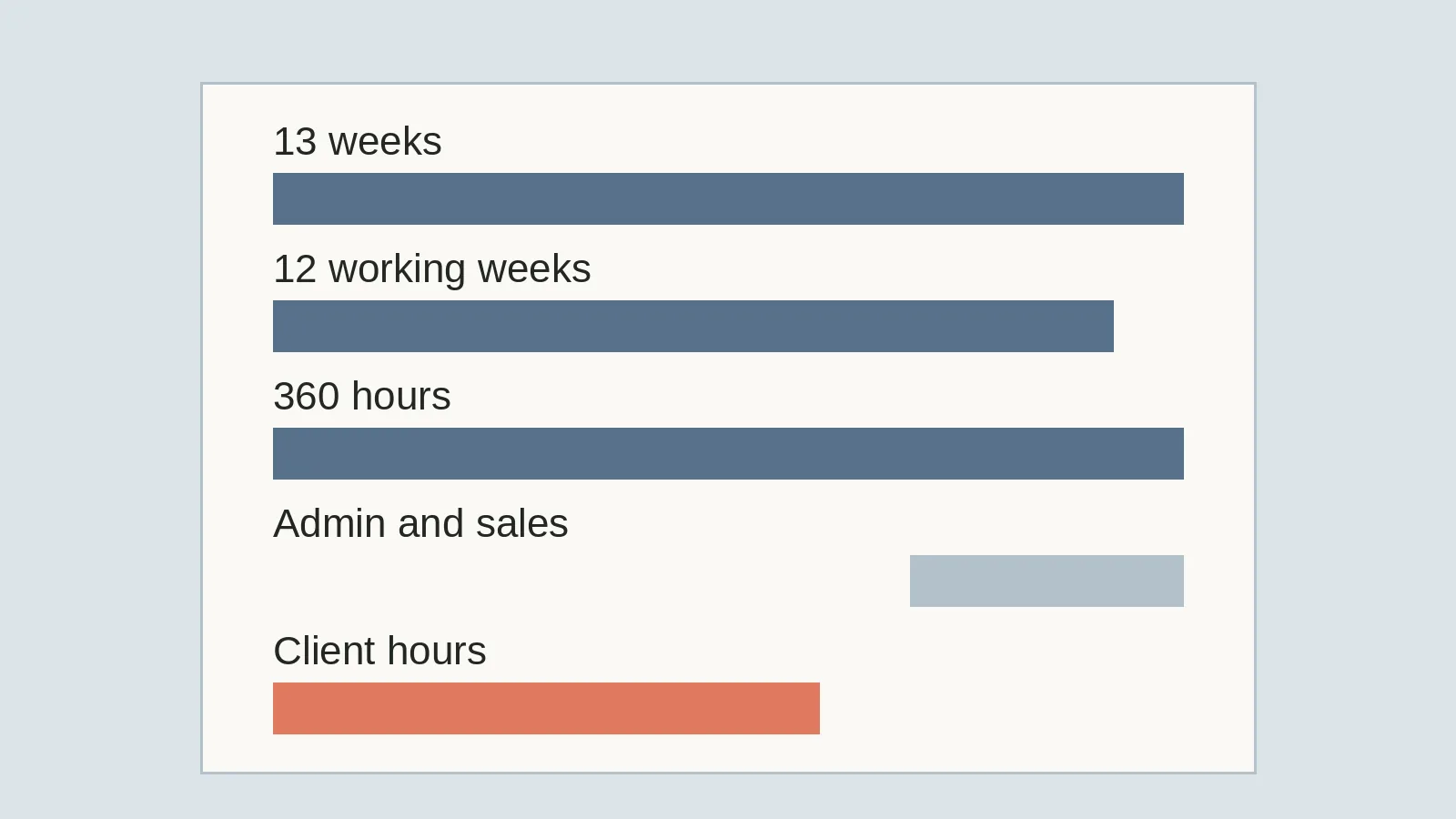
The picture is an AI illustration of a capacity sheet, with sample numbers.
Write your own capacity number at the top of the page. Every goal you pick next has to fit under it.
Step 4: Choose Up to Three Goals
Pick between one and three goals, and test each against your capacity number. Haselberger says one to three goals is typically good for a quarter. The Swan Haus guide uses the same range for its monthly focus.
The fictional developer picks three:
- Earn $12,000 from client work. At $70 an hour that needs about 172 billed hours (12,000 divided by 70 is 171.4, rounded up).
- Book two new clients. This uses sales time, about 2 hours a week for 12 weeks, or 24 hours of the 108 set aside.
- Update the portfolio. One 12-hour project, also from the non-billable pool.
As a result, the first goal needs 172 of the 216 client hours. That leaves 44 hours of room. If a fourth goal needed 60 client hours, the sheet would show at once that it does not fit.
Therefore, this is the main difference from a template-first approach. The quarterly goals template covers how to write each goal with a baseline, target and next action. Here the question is simpler: does the total fit in the hours you counted?
Step 5: Put Key Dates and a Monthly Top 3 on a Calendar
Fixed dates go on the calendar before any goal task does. Client deadlines, travel, school holidays and invoice days shape which weeks are usable.
The Swan Haus guide collects key dates first, then sets a monthly focus, then picks a monthly top three of tasks. We keep that order because it stops a plan from ignoring a week you will lose.
For each month, write one focus and up to three tasks. In the fictional quarter:
| Month | Focus | Top 3 tasks |
|---|---|---|
| Month 1 | Start the portfolio and open two client leads | Outline portfolio, send 8 outreach notes, finish current project |
| Month 2 | Deliver most client hours | Ship milestone 1, follow up leads, publish two portfolio pieces |
| Month 3 | Finish and close | Ship milestone 2, publish the rest, run the end-of-quarter review |
Also, revenue need not be flat. Months have different shapes, so write a lower and a higher figure for each and adjust as real invoices arrive.
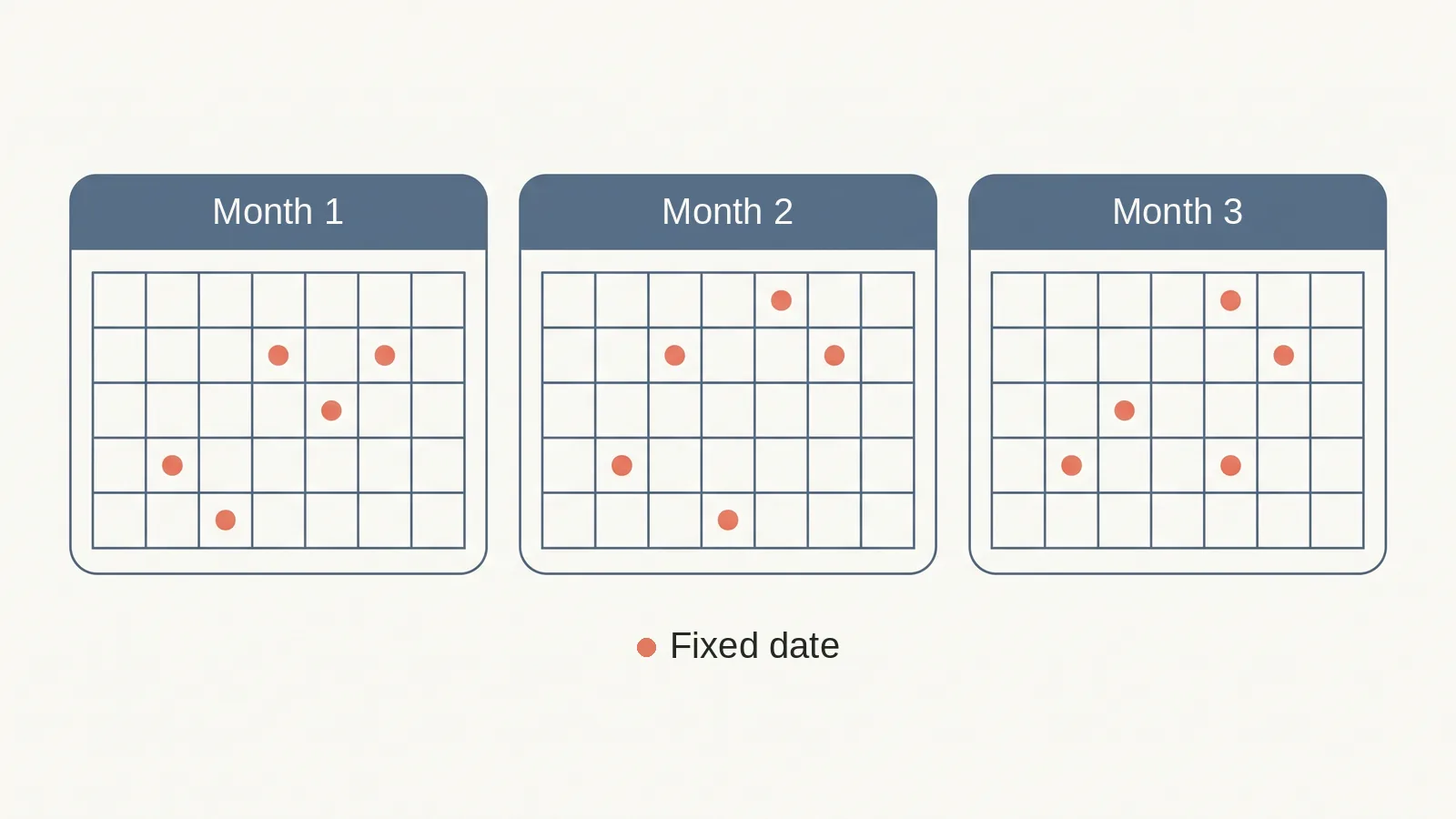
The picture is an AI illustration with sample dates.
Step 6: Book Three Review Dates
Without a review date, a plan has no check. Put three dates in the calendar before you close the session: one at the end of month 1, one at the end of month 2 and one in week 13.
Keep the first two short, about 20 minutes each. Ask: am I on pace for the capacity number, did a key date move, and is each goal still worth its hours? If you already run a weekly check, the weekly business review for one person can carry the monthly numbers with it.
Finally, Notion can hold this. Its help pages describe databases as collections of pages you can view in different ways, and relations and rollups connect data between two tables. That is enough to link a goal to its tasks and its review date, though you still choose what goes in them.
Week 13: Close the Quarter Before You Plan the Next
Treat week 13 as a close-out, not a sprint. In addition, most plans stop at "review the quarter," but a solo owner has no one to hand loose ends to. Anything left open in week 13 becomes next quarter's hidden load and silently eats the capacity you just counted.
Use week 13 in this order:
- Finish or drop each open task. Do not carry them by default.
- Send the last invoices and record what is still unpaid.
- Write the three look-back answers while the memory is fresh. This also feeds step 2 of the next session.
- Book next quarter's planning session.
Our methodology is plain: we built the fictional quarter from a short list of assumptions and showed each calculation, because the shape matters more than the numbers. If week 13 is full of client work, move the planning session to the first two days of the new quarter and say so in your calendar.
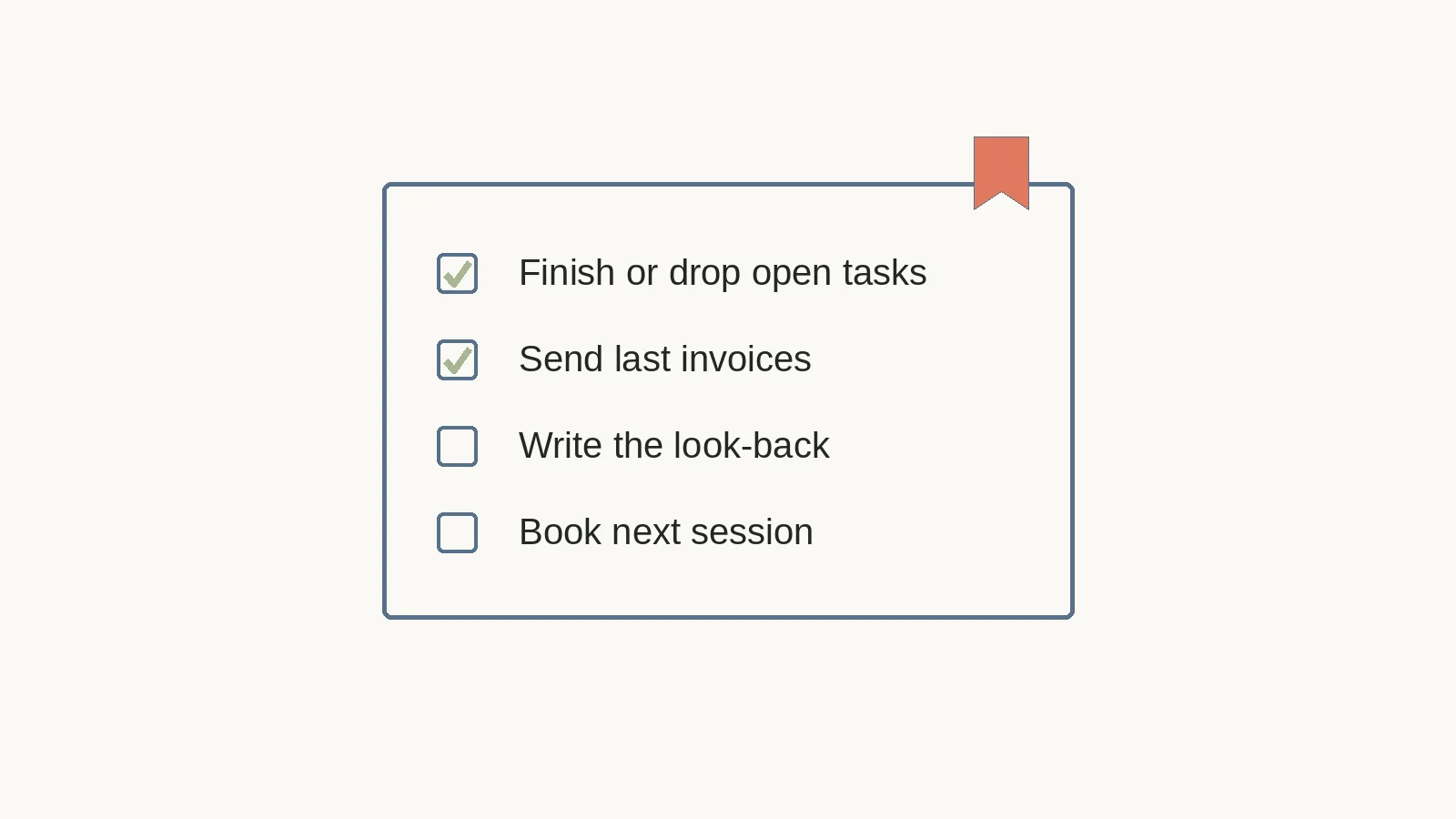
The picture is an AI illustration with sample entries.
Why Trust This Article
About us: Cosmo Suite publishes this site and the template mentioned below. Our editorial policy is to separate what a source says from what our example shows. The advice on length and format of a plan comes from the U.S. Small Business Administration. The session steps come from two published planning guides, Swan Haus and Alexis Haselberger's. We read each source on 24 November 2026, and we calculated every figure in the example by hand.
The capacity sheet and the quarter are our own fictional arithmetic, with every input shown. They are not a market benchmark or a customer result. Notion Business Planner is made by the same company, so the section below is a product reference, not an independent endorsement. Your hours and agreements will differ, so verify before you rely on any figure here.
Where Notion Business Planner Fits
The bottleneck in this method is keeping goals, hours and review dates where you will see them. Notion Business Planner lists a Business Plan and Goals page with yearly and quarterly goals and action planning, a daily, weekly and monthly planner with time tracking, and a dashboard that shows income and expenses against your target.
Those pages map to the session above: goals and actions for step 4, the planner for the monthly top three and the review dates, and the dashboard for the look-back. The listed contents do not include a capacity calculator, so you would do the hours count in step 3 on paper or in a page of your own. The template does not choose goals or tell you when to say no. You enter the records and make those choices.
This article is general business information, not financial, tax or legal advice. Compare the template's contents with how you plan before you choose a record system.
Frequently asked questions
What is quarterly planning for a one-person business?
It is a short planning session held every three months. You look back at the last quarter, count the hours you really have, choose a few goals and book review dates. For one person, the session is about capacity first and ambition second.
How long should a quarterly planning session take?
Plan for about three hours. Alexis Haselberger, a productivity coach, blocks three hours for her own quarterly planning. If you have a short plan and a clear log, you may finish sooner. Do not squeeze the session into a lunch break.
When should I do my quarterly planning?
Hold the session in the last week before the quarter starts, so the first day already has a plan. If that week is full, book it for the first two days of the new quarter. Put it in your calendar when you finish the current one.
How many goals should I plan for the quarter?
One to three. Haselberger and the Swan Haus planning guide both land on that range for one person. Each goal needs hours, so count your capacity before you choose. The goals template guide on this site covers how to write each one.
Do I need OKRs or a team process?
No. Team planning handles dependencies and owners. You are the only owner, so a short list of goals, a capacity count and a review date is enough. Use a key result format only if it helps you check the result.
What if the quarter goes off plan?
Change the plan at your next review date and write down why. A plan is a starting point for decisions, not a promise. The SBA describes the lean format as one you can regularly change and refine, which fits this approach.
Can I run quarterly planning in Notion?
Yes. Notion databases hold pages you can view as a table, a calendar or a list, so goals, key dates and monthly tasks can live in one place. You still enter the numbers and make the choices. A planner only organizes them.
Sources
Keep reading

Plan the Business
Quarterly Goals Template for a One-Person Business
Quarterly goals template: set three goals, record a baseline, schedule monthly reviews, and track progress in your one-person business each quarter.
· 8 min read

Plan the Business
Marketing Plan Template for Small Business: A One-Person Channel Plan
Marketing plan template for small business: organize your buyer, offer, channels, actions, and review dates in one clear plan for a solo service business.
· 9 min read

Plan the Business
Small Business Goals: Three You Can Track Each Month
Choose three small business goals for delivery, demand, and money, then track each with a baseline, target, next action, and monthly review.
· 8 min read
