Freelance Rates: How to Set Yours From Costs and Target Income
Freelance rates need a floor your own costs set and a market check you can verify. See how to reconcile the two, quote the result and review it.
By Notion Business Planner by Cosmo Suite · Editorial policy
Published · 10 min read
Freelance rates have to do two jobs at once. A rate has to cover your costs and the income you want the business to provide. It also has to survive a conversation with a buyer who has already seen other quotes. Most rate advice covers the first job and leaves the second, which is why the number you calculate and the number you say out loud often disagree.
This guide does both. First you build a floor from your own costs and target income. Then you check the range comparable work sells for, and reconcile the two before you quote. A fictional example shows a floor that lands above the market band, and what you can change when it does.
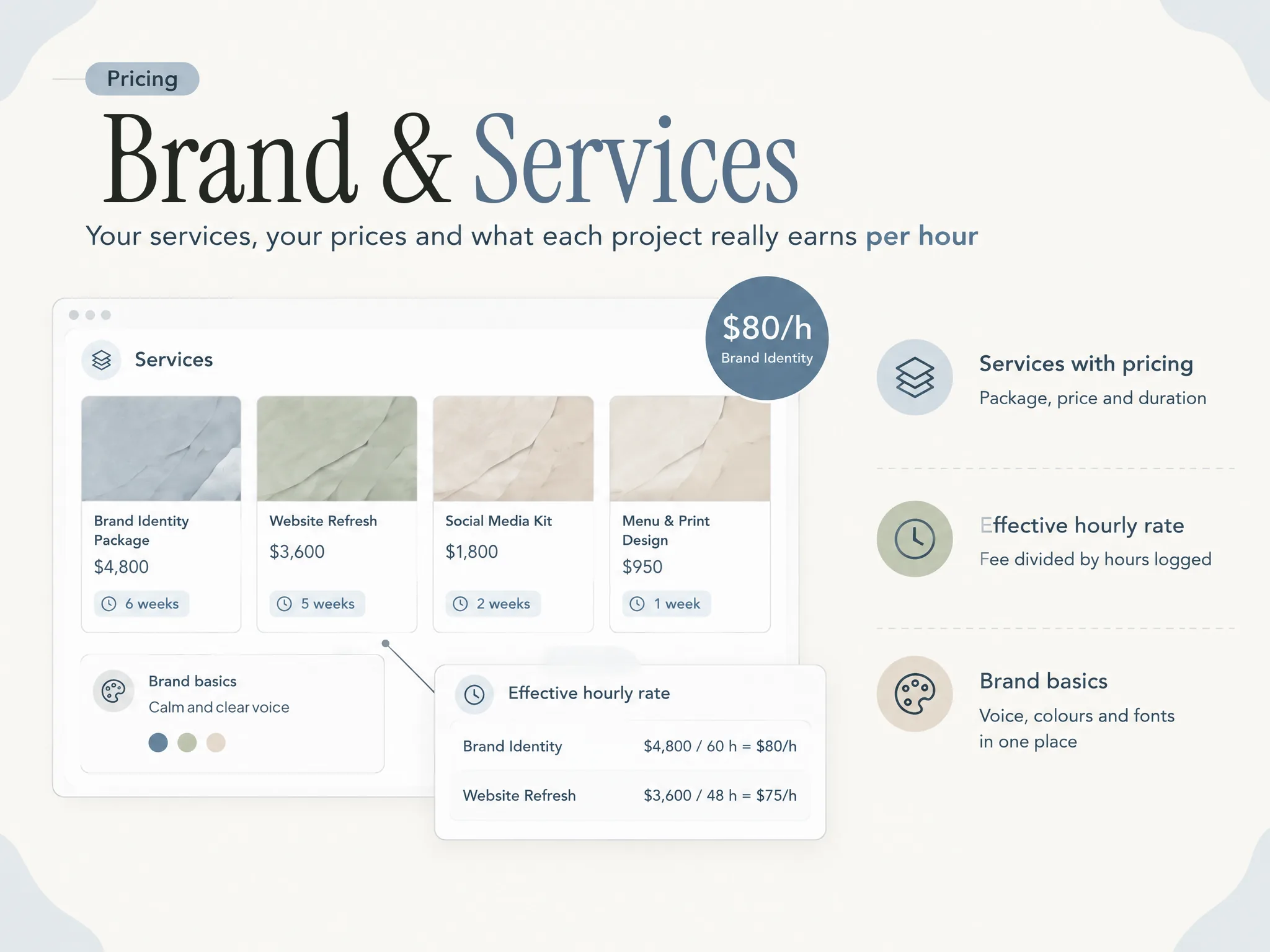
If you would rather keep the records in one place, Notion Business Planner holds a Brand & Services page for service prices and effective hourly rates next to project budgets and logged hours.
Key takeaways:
- Build the floor first: annual business costs plus your pre-tax income target, divided by the hours you expect to bill.
- Check a band of comparable quotes, not one competitor's number.
- When the floor sits above the band, change hours, costs or scope. Do not bend the arithmetic.
- Quote from the reconciled number, and put a review date on it.
Freelance Rates at a Glance
A freelance rate is the price you charge for an hour, a day or a project. The defensible version is built from your own numbers first, and only then compared with anyone else's.
| Input | Where it comes from | Sample value | Why it matters |
|---|---|---|---|
| Annual business costs | Your own records | $18,000 | Must be covered before the business pays you anything |
| Pre-tax income target | Your own decision | $60,000 | The amount the business has to provide |
| Hours you expect to bill | Work hours × billable share | 890 | The denominator that decides the rate |
| Cost floor rate | (Costs + income) ÷ hours | $87.64 | The lowest rate that still covers both |
| Market band | Three to five comparable quotes | $70 to $95 | The range a buyer may already have seen |
| Rate you quote | Your reconciled choice | $88 | The number you actually say |
The sample values are round inputs chosen to make the arithmetic readable. They are not a market rate and not a recommended income. Replace every one with your own figures.
Two of the six rows come from inside your business. The other four come from a calculation and a comparison, and they only make sense in that order. A rate set from the market alone will not tell you whether it covers your costs.
For example, a rate that matches the middle of the band still loses money if your own costs sit above it. The floor is what turns a plausible number into a defensible one.
Set the Floor From Your Own Numbers
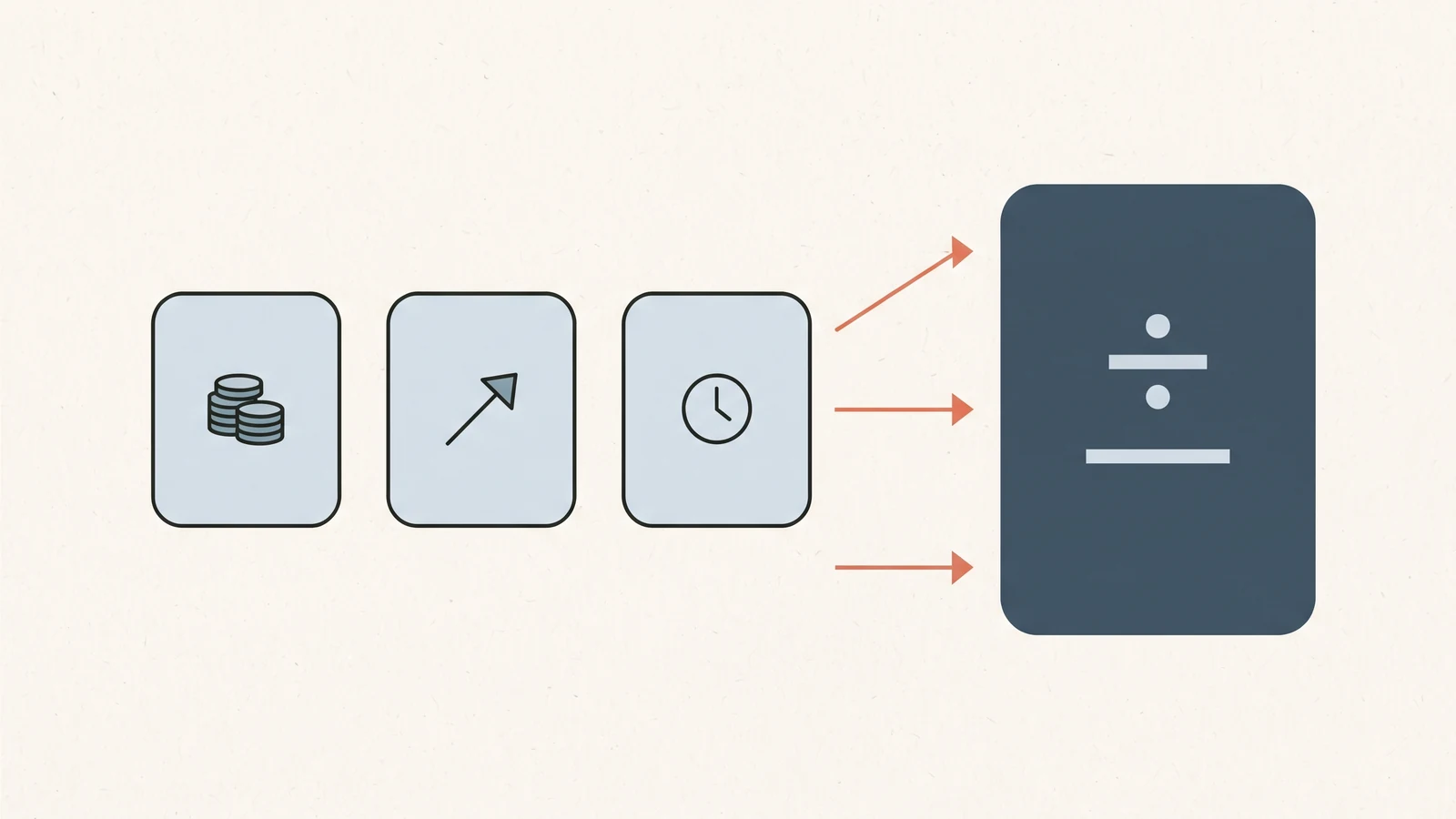
A cost floor rate is the lowest rate that still covers your costs and the income you want, and it comes from one division. Add your annual business costs to the pre-tax income you want, then divide by the hours you expect to bill.
Cost floor rate = (annual business costs + pre-tax income target) ÷ annual billable hours
The U.S. Small Business Administration's guide to startup costs separates one-time outlays from recurring monthly costs, and it recommends budgeting for at least a year of monthly expenses. That separation matters here, because a recurring cost belongs in your floor every year while a one-off purchase belongs in a replacement reserve.
Take the three inputs in turn.
Annual business costs. Software, insurance, accounting, equipment replacement, payment fees, and any workspace cost. Use last year's actuals if you have them, and adjust for anything you know changed. If you are in your first year, estimate from your own planned spend rather than from someone else's list.
Pre-tax income target. Decide the amount the business must provide you in a year. This is a choice, not a discovery. Write it down so you can revisit it on a review date.
Annual billable hours. Start from the hours you actually work in a week, subtract the weeks you will not work, then apply a billable share. A 36-hour week across 45 weeks is 1,620 work hours. At a 55% billable share, that is about 891 billable hours, which the table above rounds to 890.
The billable share is where most estimates go wrong. Sales calls, proposals, invoicing and admin all take hours and none of them appears on a client invoice. If you have logged a few weeks, use the real share rather than the one you hope for.
With those three figures, $18,000 plus $60,000 is $78,000, and $78,000 divided by 890 is $87.64. That is the floor. Any rate below it means the business covers less than its costs and your target, whatever the market says.
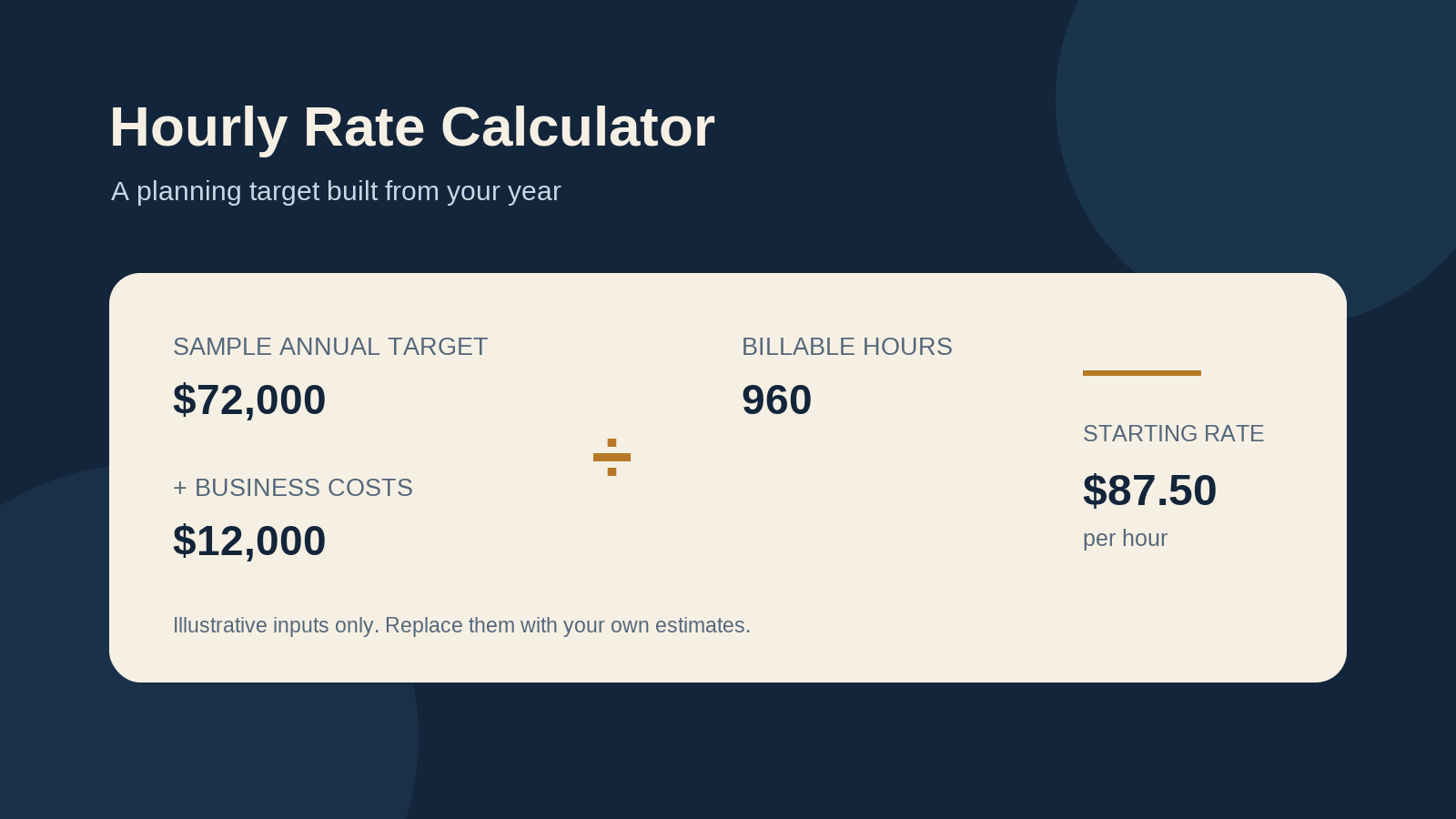
If you want to see the same division worked through with different inputs and a billable-share table, the hourly rate calculator guide builds a starting rate from an annual target.
Check a Market Band, Not a Single Number
A market band is a range built from several comparable quotes, and it is more useful than one competitor's rate because a single number hides the scope and experience behind it. A rate survey is a published collection of rates with a stated date and sample, and it is only as useful as those two details are checkable.
The SBA's market research and competitive analysis guidance asks a direct question: what do potential customers pay for these alternatives? That question produces a range, not a point. Collect three to five quotes or published prices for work that closely matches yours in scope, deliverable and level. Note the scope next to each figure, because a quote for a smaller deliverable is not a comparison.
From those, take the low end, the high end and the midpoint. In the sample above the band runs from $70 to $95, with a midpoint of $82.50.
Treat the band as a check, not a target. It answers a different question from the floor: the floor asks what you need, and the band asks what buyers in your discipline have been paying. Both answers are useful and neither is a verdict on its own.
Published rate surveys are a reasonable input if you check three things: the date, the sample size, and the discipline. A survey that mixes every kind of freelance work gives a range too wide to price from. A survey with no date may describe a market two years old. Cite the number with its date when you use it, so a reader can see what you relied on.
When Your Floor Sits Above the Market
A floor above the band is the common case for a careful solo operator, and the useful response is to test which input is doing the damage.
In the sample, the floor is $87.64 and the band midpoint is $82.50. The gap is $5.14 an hour, about 6%. Three levers can close it, and each one changes a real input in the business. The hours lever closes the whole gap, while the cost lever only narrows it.
Raise the billable share. A billable share is the portion of your working hours that reaches client work. If the same 1,620 work hours reach a 62% share, that is 1,004 billable hours. Now $78,000 divided by 1,004 is $77.69, which sits inside the band. Part of the rate problem was an hours problem, because more of the week has to reach client work. Trim admin, or charge for work you currently absorb.
Trim a cost you can do without. Every $3,000 removed from annual costs lowers the floor by about $3.37 an hour at 890 hours. That is a real change, and it is also the lever with the least room, because costs you cut usually come back.
Narrow the scope you sell. Suppose part of your work sells at the top of the band and part sells at the bottom. Moving toward the upper part raises the average without touching your costs or your hours. This is the slowest lever and often the most durable one.
| Lever | Change | New floor | Effect on the gap |
|---|---|---|---|
| None | Base case | $87.64 | $5.14 above the midpoint |
| Billable share | 55% to 62% | $77.69 | Now inside the band |
| Costs | $3,000 lower | $84.27 | Gap narrows to $1.77 |
| Scope | Mix shifts upward | Unchanged | Average quoted rate rises |
Run one lever at a time so you can see which one moved the result. Changing all three at once gives you a new number and no idea which input to watch next year.
From One Rate to an Hourly, Day and Project Price
An hourly rate is the base unit, and the other shapes are conversions of it, each with a different risk attached.
Hourly. The floor rate with a margin for the work you cannot bill. Simple to explain, and it puts the risk of overrun on the client.
Day rate. A day rate usually bundles a fixed number of hours, and the useful version states how many. Seven hours at $88 is $616, but if the work regularly runs to nine hours, the effective rate drops. The comparison of day rates and hourly rates works through that break-even point.
Project fee. Estimate the hours, multiply by the rate, then add an allowance for the risk in the scope. A fixed fee is only safe when the scope is bounded and written down.
Whichever shape you quote, keep the hourly floor behind it. That way a day rate or a project fee can be checked against your own costs instead of against how the number felt when you said it.
The Part Most Rate Guides Leave Out
Choosing the number is the easy half. Whether it holds depends on what you do in the months after you quote it.
Put a review date on the rate. Choose it when you set the rate, not when you notice the problem. Six months is a common interval for a solo business, and any change in costs, hours or booked work is a reason to look earlier.
Compare the rate you planned with the rate you earned. An effective rate is a fee divided by the hours it actually took. It is the honest check on whether the quote held. The breakdown of effective hourly rate shows how to run that division after a project closes.
Watch the hours side as closely as the price side. A rate that looks fine can still underpay if too little of the week reaches client work. Your utilization rate is the share of working hours that reaches client work, and admin hours belong in the total.
Raise the rate on new work first. A new client has no history with your old number, so the new rate applies without a renegotiation. Existing clients can move at their next review.
Record what you quoted and why. The inputs, the band you checked and the date are the evidence for the next review. Without them, each rate decision starts from memory.
Why trust this article
This guide keeps two things apart. The formula and the arithmetic are shown with every input visible. The market check is a range to verify, not a rate to copy. Notion Business Planner is published by the same company, so its mention below is a product reference rather than an independent endorsement.
The method draws on the U.S. Small Business Administration's guidance on costs and on market research, and on Indeed's ten steps for pricing freelance work, all checked on 21 November 2026. The worked example is fictional arithmetic with stated inputs, not customer data or a market benchmark. Your costs, discipline and market may differ, so verify the figures before you act on them.
Where Notion Business Planner fits
Notion Business Planner includes a Brand & Services page for listing services, prices and effective hourly rates, and project pages that hold budgets and logged hours. Its dashboard shows income and expenses against target, plus invoices paid or unpaid.
That combination is what a rate review needs. The Brand & Services page holds the number you decided. The project pages hold the hours that number had to cover. Planned rate and earned rate then sit in the same workspace instead of in a spreadsheet and a memory.
The template does not calculate a market band or recommend a rate. You supply the inputs, choose the band to check against, and enter the records. Compare its listed contents with how you already work before you pick a record system.
Editorial source note
This article is published by the maker of Notion Business Planner, which appears above as one possible record-keeping option. The freelancer, the costs, the income target, the hours and every rate in the example are fictional. They do not describe customer results or a market benchmark.
The pricing method draws on the U.S. Small Business Administration's pages on startup costs and competitive market research, and on Indeed's career guide to pricing freelance work. Those sources support the concepts described here, and the worked example is original arithmetic using stated assumptions.
This guide is general business information, not financial, legal, tax or accounting advice. Your costs, market and client circumstances may differ, so check local requirements and take qualified advice where you need it.
Frequently asked questions
How do I work out my freelance rate?
Add your annual business costs to the pre-tax income you want the business to provide, then divide that total by the hours you expect to bill in the year. The result is a floor: the lowest rate that covers both. Compare it with what comparable work sells for before you quote, and quote a number you can defend from those two checks.
Should I copy a competitor's rate?
Use several comparable quotes as a band, not one competitor's number as a target. A single rate may reflect a different scope, a different level of experience, or a different set of costs. Three to five comparable quotes with similar scope tell you more about the range a buyer has already seen.
What if my calculated rate is higher than the market?
That gap is information, not a problem with the arithmetic. Check the hours you expect to bill, the costs you carry and the scope you offer. Raising the billable share, trimming a cost you can do without, or narrowing to work that sells at the top of the band each changes the answer in a different way.
Does the rate include tax?
The floor in this method uses a pre-tax income target, so the rate is before personal tax. It also sits before any tax you set aside as a business. The rate is a pricing input, not a tax calculation, so confirm your own obligations with a qualified professional.
How often should I review my freelance rate?
Set a review date in advance, such as every six months, and also review after any change in your costs, your available hours or your booked work. Comparing planned rates with the effective rate you actually earned shows whether the number still holds.
Is an hourly rate always the right way to quote?
No. An hourly rate is the base unit that the other shapes are built from. A day rate or a fixed project fee can suit work where the scope is clear and the buyer prefers one number. Whatever shape you use, keep the hourly floor behind it so you can check the price against your own costs.
Sources
Keep reading
Money and Pricing
Hourly Rate Calculator: Set a Target From Your Workweek
Hourly rate calculator: turn an income target, business costs, and billable hours into a starting rate, then see how your workweek changes the result.
· 8 min read
Money and Pricing
Effective Hourly Rate: How to Calculate What a Project Pays
Calculate an effective hourly rate for fixed-fee work with a simple fee ÷ hours formula, three labelled project examples, and a checklist for your next quote.
· 9 min read

Money and Pricing
How to Price Services: Three Methods for a Clear Quote
How to price services: compare a cost floor, similar offers, and project scope with a practical quote method for solo freelancers and service providers.
· 8 min read
