How to Price Services: Three Methods for a Clear Quote
How to price services: compare a cost floor, similar offers, and project scope with a practical quote method for solo freelancers and service providers.
By Notion Business Planner by Cosmo Suite · Editorial policy
Published · 8 min read

Price a service by checking three things: what the business needs to earn, what similar offers include, and what the agreed work will take. A cost floor gives you a starting point. A market check gives context. A written scope helps you decide whether the fee fits the work and risk.
The method is for solo freelancers who need to quote work before they know the exact time each task will take. The numbers below are hypothetical examples. They are not market rates, income promises, or tax advice.
Key takeaways:
- Calculate a planning floor from costs, planned owner compensation, and realistic billable hours.
- Compare services with similar deliverables and terms, not just a matching job title.
- For a fixed fee, put the deliverables, assumptions, revisions, and change process in writing.
- After delivery, compare the fee with the hours and scope you recorded.
How to price services at a glance
Use a cost-based check, a market comparison, and a scope-and-value check together. Each answers a different question, so no single method can tell you what every client should pay.
| Check | What to look at | What it helps answer | Limit |
|---|---|---|---|
| Cost floor | Business costs, planned compensation, available billable time, direct project costs | Can the work support the business plan? | It does not show what buyers will accept. |
| Market comparison | Similar buyer, deliverable, timing, support, and location | How are comparable services presented and priced? | A competitor’s price does not prove your costs are covered. |
| Scope and value | Deliverables, client inputs, impact, uncertainty, and responsibility | Does the fee make sense for this defined engagement? | The client’s hoped-for outcome may be uncertain or outside your control. |
For a clear project, a fixed fee can give both sides one price for a stated scope. For work that is hard to estimate or likely to change, hourly or phased pricing can make the uncertainty visible. Either model needs an agreed way to handle added work.
Fixed-fee quote is one agreed price for a defined set of deliverables. It works best when the work and its boundaries are clear enough to estimate.
Calculate a floor before choosing your fee
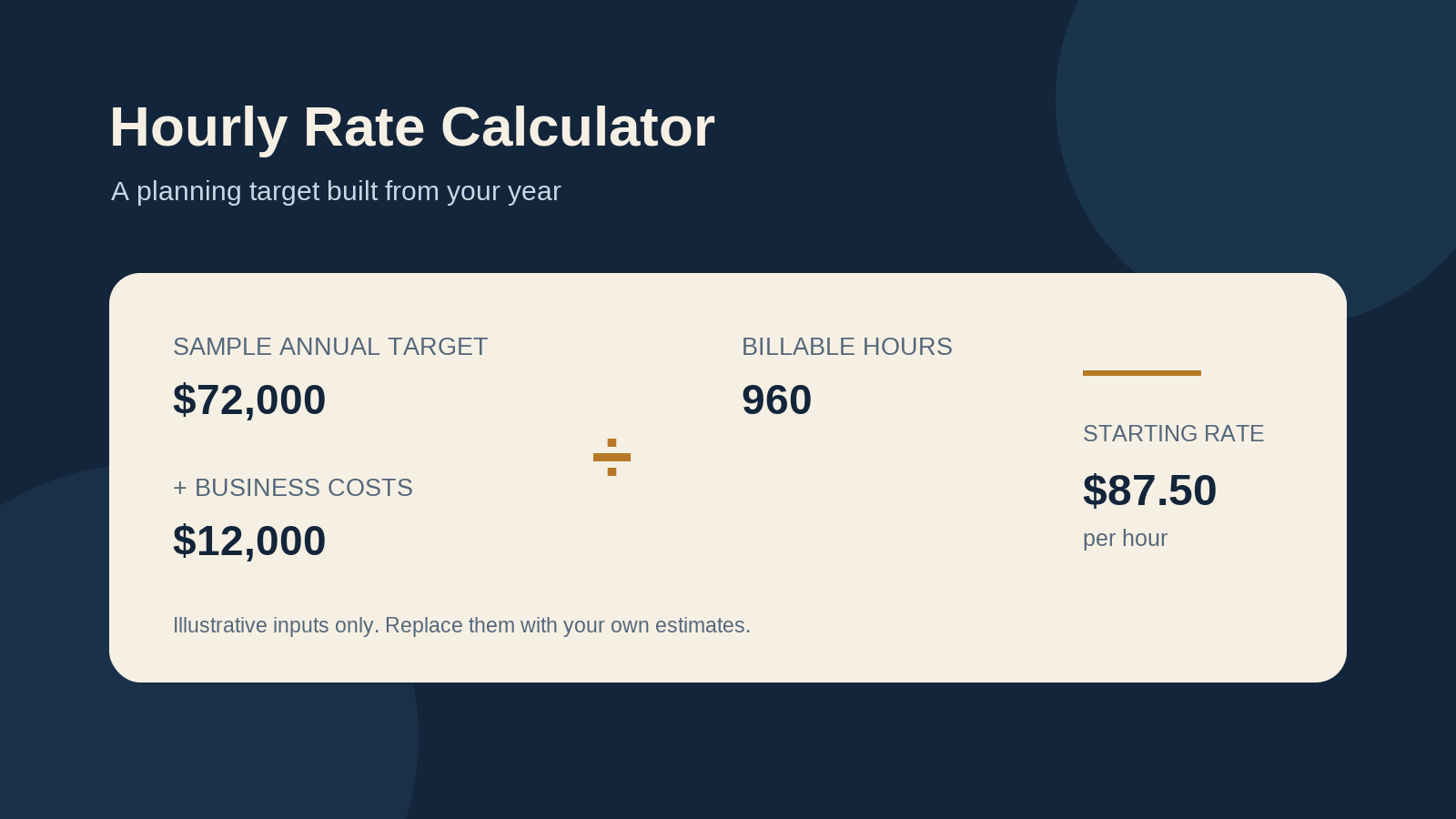
A simple planning floor divides the amount your business needs to cover by the billable hours you expect to sell in the same period. Treat it as a starting assumption to examine, not a universal rate or a substitute for a full financial plan.
Cost floor is a planning estimate of what a service needs to earn before it can support the business. Effective hourly rate is a completed project fee divided by the hours recorded for that project. They answer related questions, but use different inputs.
Planning floor per billable hour = (planned business costs + planned owner compensation) ÷ expected billable hours.
For example, suppose a freelancer uses these hypothetical monthly inputs:
| Planning input | Hypothetical amount |
|---|---|
| Business costs for the month | $1,200 |
| Planned owner compensation before personal taxes | $5,200 |
| Expected billable hours | 80 hours |
| Simple planning floor | ($1,200 + $5,200) ÷ 80 = $80/hour |
This simplified calculation assumes the inputs cover the period consistently. It does not estimate personal tax, account for every kind of expense, or guarantee that 80 billable hours are available. Work such as sales, administration, learning, and leave can reduce the time available for client projects. The figure is a planning input, not a recommended public rate.
The SBA break-even guide explains break-even analysis as a way to compare costs and revenue. Its service formula also uses fixed costs, variable cost per service, price, and sales volume. The SBA calculator separates fixed and variable costs. Use those tools for a fuller business estimate; the simple hourly floor above only helps you make a first pass at your own assumptions.
For the project itself, add direct costs that arise because you take that work, such as a required license, paid asset, or subcontractor. State whether those costs are included in your quote or billed separately. Then check the hourly rate calculator guide if you want to compare a target amount with your expected working hours.
Turn the service into a quoteable scope
A fixed fee is only useful when the client and provider can tell what the fee covers. Write down the deliverables, client inputs, timing, revision rounds, exclusions, and how either side can approve a change.

Consider a hypothetical $2,400 project that you estimate will take 24 hours. Its estimated effective rate is $100 per hour. If the same scope takes 30 hours and the fee does not change, the effective rate becomes $80 per hour. The fee stayed fixed; the time assumption did not.
That difference is not a reason to add an arbitrary buffer to every quote. It is a reason to record what you estimated, define the included work, and note why the actual hours changed. If a client asks for another deliverable, decide whether it replaces something in the scope or needs a separate fee and timeline before starting it.
A practical scope note can answer these questions:
- What will the client receive, and in what format?
- What must the client provide, and by when?
- How many review rounds are included?
- What work is outside the fee?
- What happens if the brief or schedule changes?
After the project, use the recorded fee and time to calculate its effective hourly rate. Keep the project result separate from a cash-flow question: an agreed fee and money received are different records.
Compare similar services without copying a competitor
Use competitor prices as context, then inspect what each price includes. A “website refresh” or “brand package” can describe different work, review time, deadlines, and support. A headline price alone may not give you a fair comparison.
The SBA market research guide recommends looking at what potential customers pay for alternatives and researching the target market. Turn that into a small comparison sheet: record the provider, buyer, deliverables, timeline, support, listed price, and date checked. Leave a cell blank when the provider does not publish a detail; do not fill it by guessing.
Compare like with like. If one provider includes research and two rounds of revisions while another lists production only, those offers are not equivalent. If the public examples do not match your location or customer, treat them as clues for further research rather than a market average.
You can also ask prospective customers what they considered and what mattered in their choice. Keep the questions neutral. A few conversations can clarify the language buyers use, but they do not establish what an entire market will pay.
Check the client value and the risk you carry
Value-based pricing starts with the result or benefit a client seeks, then checks how much of that result your work can credibly influence. It is useful context for a proposal, but a hoped-for client outcome is not the same as a guaranteed result.
The SCORE guide to pricing products and services describes cost-plus and value-based methods and notes what each leaves out. For a service quote, ask what the client is trying to change, what you will deliver, what depends on the client, and what uncertainty remains. Then price the work you can define and deliver.
For example, a designer may be asked to create a brand identity before a product launch. The designer controls the agreed identity files and delivery process, but not the product’s sales after launch. A fee can reflect research, design, licensing, and the defined deliverables. It should not imply a sales result unless both parties have a way to measure and contract for that result.
Use hourly pricing when the work is exploratory and the time cannot yet be estimated with confidence. Use a fixed fee when the deliverables and boundaries are clear enough to estimate. A phased quote can work when the first stage will answer questions that affect later work. In each case, state what the client gets and when you will revisit the estimate.
Use a three-pass quote check
Before sending a quote, compare your draft fee with your floor, your market notes, and the exact work you agreed to do. When the checks point to different numbers, review the scope and assumptions before sending the quote.

- Check the floor. Does the fee cover the time and direct costs you expect, using realistic capacity?
- Check the comparison. Are the alternatives similar in buyer, deliverables, support, and terms?
- Check the scope and risk. Can you define the deliverable and separate work you cannot control?
- Write the boundary. Note assumptions, client inputs, revisions, timing, exclusions, and the change path.
- Review the result. After delivery, compare estimated hours with recorded hours and update the next quote when the evidence supports it.
If the client’s budget is below the fee, you can reduce or phase the scope and show what changes. Do not keep the same deliverables while silently removing time you need to complete them. If there is no useful scope that fits, decline the work or suggest a later start.
Keep pricing records together
Review a service price when your costs, capacity, scope, or buyer expectations change. A record of the service, fee, planned hours, actual hours, and scope changes helps explain why one project paid differently from another.
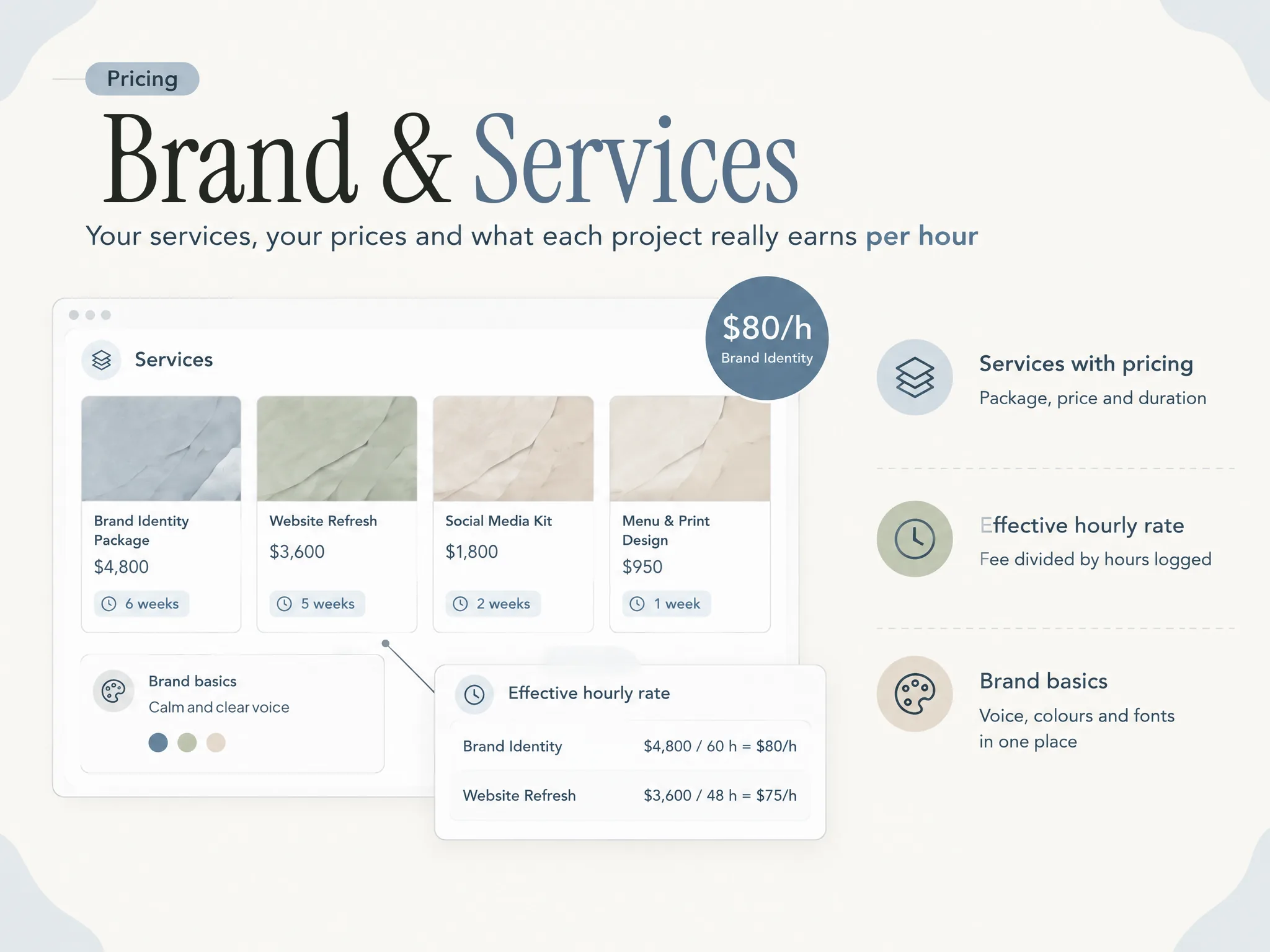
Notion Business Planner’s Brand & Services page lists services with pricing and an effective hourly rate. Its project pages can hold budgets and logged hours. You can use those fields to keep a price review near the work, or use a spreadsheet with the same information. The Notion Business Planner workspace includes these planning pages. It does not send invoices or determine a price for you.
The Notion Business Planner home page lists the published contents. This tool does not send invoices or set a price for you.
For the wider business plan, see the guide to a freelance business plan. For your next quote, keep the written scope and hour estimate with the final project record.
The sample arithmetic in this guide was checked on 31 October 2026. The examples are hypothetical. The cited SBA and SCORE pages describe general pricing and planning methods; your costs, terms, local rules, and client needs may differ. Consult a qualified professional for tax or legal questions.
Notion Business Planner by Cosmo Suite publishes this guide. For the publisher and correction process, see the about page and editorial policy. Contact the publisher through the about page if you find an error.
Frequently asked questions
What is a simple way to price a service?
Start with a cost floor based on your business costs, planned owner compensation, and realistic billable capacity. Then compare similar offers and check that your scope, fee, and delivery risk fit together.
How do I calculate a minimum price for my services?
For a planning estimate, add the business costs and owner compensation you want the business to cover for a period, then divide by the billable hours you expect to sell in that period. Include direct project costs separately and review the assumptions.
Should freelancers charge hourly or per project?
Hourly pricing can fit work whose scope or duration is uncertain. A fixed project fee can fit a clearly described deliverable that you can estimate. Either way, state what is included and how extra work will be priced.
How do I price services when I am new?
Estimate the work from a written scope, calculate your cost floor, and research comparable offers for a similar buyer and deliverable. Treat the first quote as a test of your assumptions, then compare planned and actual hours after delivery.
How often should I review my service prices?
Review a price when your costs, scope, capacity, or market changes. After a fixed-fee project, compare the hours you planned with the time you recorded before deciding whether to change the next quote.
Does a service price need to include taxes?
Tax rules depend on where you operate and what you sell. This planning method is not tax advice. Check official tax guidance or ask a qualified tax professional about your situation.
Sources
Keep reading
Money and Pricing
Effective Hourly Rate: How to Calculate What a Project Pays
Calculate an effective hourly rate for fixed-fee work with a simple fee ÷ hours formula, three labelled project examples, and a checklist for your next quote.
· 9 min read
Money and Pricing
Hourly Rate Calculator: Set a Target From Your Workweek
Hourly rate calculator: turn an income target, business costs, and billable hours into a starting rate, then see how your workweek changes the result.
· 8 min read
Money and Pricing
Billable Hours vs Non-Billable Hours: Log Both When You Work Alone
Billable hours are only part of your week. Log billed, absorbed and non-billable time, then see what an hour of work really pays, with a worked example.
· 8 min read
