Freelance Business Plan: A One-Page Plan You Can Fill In Today
Freelance business plan in one page: six sections to fill in, a worked example for a solo designer, and a quarterly review so the plan stays alive.
By Notion Business Planner by Cosmo Suite · Editorial policy
Published · 8 min read
A freelance business plan is a short document that says who you serve, what you sell, what you charge, what you want to earn and how clients will find you. For a solo service business it fits on one page, and the page matters less than the review you hold on it every quarter.
Most independent professionals skip a written plan for one of three reasons. They assume plans are only for people raising money. They are unsure what to write. Or they wrote one once, saved it in a folder and never reopened it. All three are fair objections.
The practical solution is a smaller, simpler plan. The US Small Business Administration (SBA) says a traditional plan can run to dozens of pages, while a lean one is typically one page and can take as little as one hour to make. For one person, the lean version is the right size.
Below are the six lines to fill in, a worked example, and the review habit that keeps the plan useful.
Key takeaways:
- A one-page plan covers six lines: client, offer, price, income target, channels and quarterly goals.
- Price from the income you need, then check the hours the work takes.
- Review the plan once a quarter and change one line each time.
- The SBA describes lean plans as typically one page, against dozens for a traditional plan.
Why a One-Page Plan Beats a Long One
A one-page plan works because you can read it in a minute. According to the SBA's guide to writing a business plan, a traditional plan has nine sections. Two of them are a funding request and financial projections. Those serve a lender. They do not help you decide whether to take a client at $40 an hour.
A lean plan drops the lender sections and keeps the choices you make every week: who, what, how much, how.
If you do need a loan or a grant, you can expand the one page later. The reverse is harder. Few people manage to condense a thirty-page plan into something they genuinely use.
The Freelance Business Plan at a Glance
The table below is the whole plan. Each row is one line you write, and the last column says which decision it settles.
| Section | The question | Example line | Decision it settles |
|---|---|---|---|
| Who you serve | Which clients do you want more of? | Small wellness studios | Which leads you accept |
| What you sell | What do you deliver, in plain words? | Brand identity packages | What you pitch |
| Your price | What do you charge, and for how many hours? | $2,400 per package | Whether a project is worth it |
| Income target | What do you need per month? | $5,000 | How many projects you need |
| How clients find you | Which two channels will you use? | Referrals, one LinkedIn post a week | Where your time goes |
| This quarter's goals | What three things will you finish? | Two new packages, ten leads | What you say no to |
Fill every row with a rough answer first. A correctable estimate beats a blank space.
The Six Sections, Filled In
Who you serve: name a type of client, not "small businesses"
Write one sentence that a stranger could use to spot your ideal client. "Small businesses" is too wide to act on. "Wellness studios with one to three locations" tells you where to look and what to say.
If you have no clients yet, choose the group you understand best from previous employment or projects. You can revise that choice after your first five engagements.
Best for: anyone who gets mixed leads and says yes to all of them.
What you sell: name two or three offers
List the two or three things you deliver, each with a start and an end. "Design help" is vague. "Brand identity package: logo, colors, fonts, one-page guide" is a product.
Fewer offers make pricing, positioning and marketing much easier. Add further offerings later, once a client has requested them more than once.
Best for: freelancers who sell hours and want to sell outcomes.
Your price: start from the income you need
Work backwards from your income target. For example, say you want to take home $5,000 a month and set aside 25% for taxes and costs. That means you need about $6,667 in billings. At $2,400 a package, that is three packages a month.
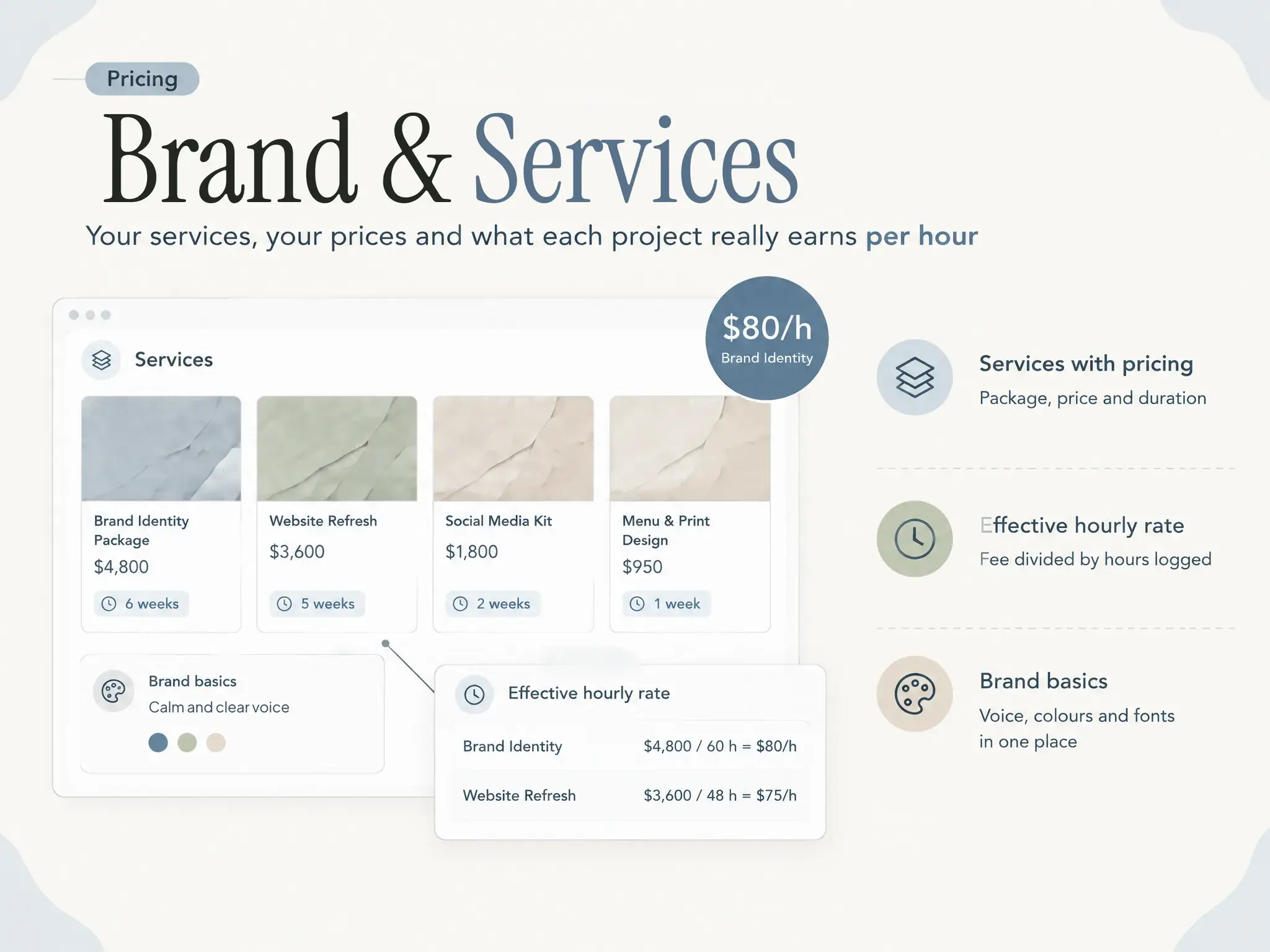
Then check the hours. If a package takes 30 hours, three packages is 90 hours, and $2,400 over 30 hours is $80 an hour. If your calendar only has 70 free hours, the plan tells you now, before you promise the work. The 25% is an example, not advice; use the figure your own tax adviser or official tax page gives you.
The planner's Brand and Services page shows each service with its pricing and the effective hourly rate per project, which is this same check in a table.
Your income target: one number per month
Pick one monthly number and one yearly number. The monthly number is what you track. The yearly one keeps you honest about slow months.
Use sample figures if you are uncertain, and label them clearly as provisional guesses. After a quarter of real data, replace them.
How clients find you: two channels, not six
Choose two channels and give each a weekly action. "Referrals: message two past clients every Monday" is a plan. "Be active on social media" is a wish.
Two channels are sufficient for one person to maintain consistently, week after week. Spread across six, each channel receives too little attention to produce a measurable result.
This quarter's goals: three, with numbers
Write three goals for the next 13 weeks, each with a number. "Get more clients" cannot be checked. "Book four new clients" can.
Three is a deliberate limit. Every additional goal takes hours away from the other two.
What a Filled-In Plan Looks Like: A Solo Designer
For example, here is the same plan for a made-up solo brand designer. The numbers are an illustration, not data from real clients.
Plan: Q4, solo brand designer (sample)
- Serve: wellness studios with one to three locations.
- Sell: Brand identity package at $2,400; logo refresh at $900.
- Price check: 30 hours per package, so $80 an hour.
- Target: $5,000 take-home a month, about $6,667 billed.
- Find me: two past-client messages each Monday; one LinkedIn post a week.
- Q4 goals: book four packages; publish two case studies; ask for three referrals.
That is roughly ninety words, and it already tells the designer exactly what to do on Monday morning. You can build the same plan in a notes app. A Notion workspace helps because the plan can sit next to your clients, projects and invoices in one place, so the quarterly review draws on real figures.
Keep the Plan Alive With a Quarterly Review
Review the plan once a quarter, and glance at the numbers once a month. A plan that is never reopened becomes outdated within a few weeks.
A quarterly review typically takes approximately an hour:
- Compare income against your target, month by month.
- Compare hours logged to hours planned.
- Mark each goal done, not done or dropped.
- Change one line of the plan, not six.
- Write the next three goals.
The SBA notes that lean plans suit people who expect to change and refine their plan often. That fits a freelancer, whose mix of clients and prices shifts every few months.
What Actually Makes a Plan Work
The plan works when the numbers come from what you actually did. Most freelance plans fail at the review, not the writing, because the income, hours and unpaid invoices live in three different places.
Three habits help:
- Record information as you go. Record hours and invoices the day they happen, not at month end.
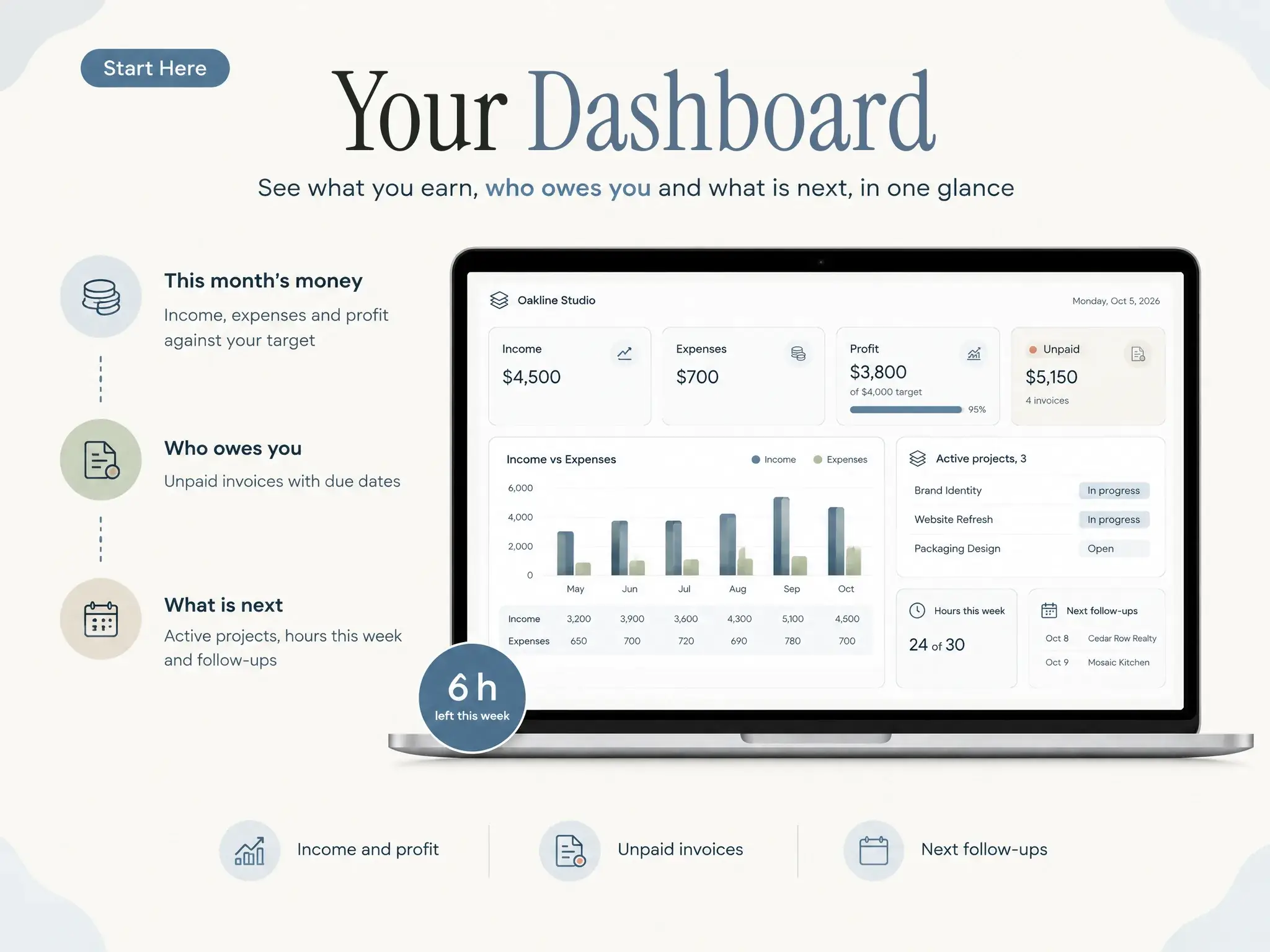
- Look at one page. A single dashboard of income, unpaid invoices and active projects is easier to open than five tools.
- Change one thing at a time. After each review, fix the biggest gap and leave the rest.
Why Trust This Article
We are the Cosmo Suite team that builds the Notion Business Planner. That gives us a stake in the tool described in the last section. The planning method above works in any notes application or spreadsheet. The one outside fact, about plan length, comes from the US Small Business Administration page linked in the sources. We checked it on 13 October 2026. The solo designer and all dollar figures are made-up examples. The figures were fact-checked against the arithmetic shown. Read how we make posts on the editorial policy page and who we are on the about us page, where you can also find how to contact us with corrections. Check any tax or loan figure with an adviser or an official source before you act.
Where Notion Business Planner Fits
Notion Business Planner is a single Notion template that puts the plan, the money and the clients on linked pages. The bottleneck in the section above is keeping the plan next to real numbers. That is what the planner is built for.
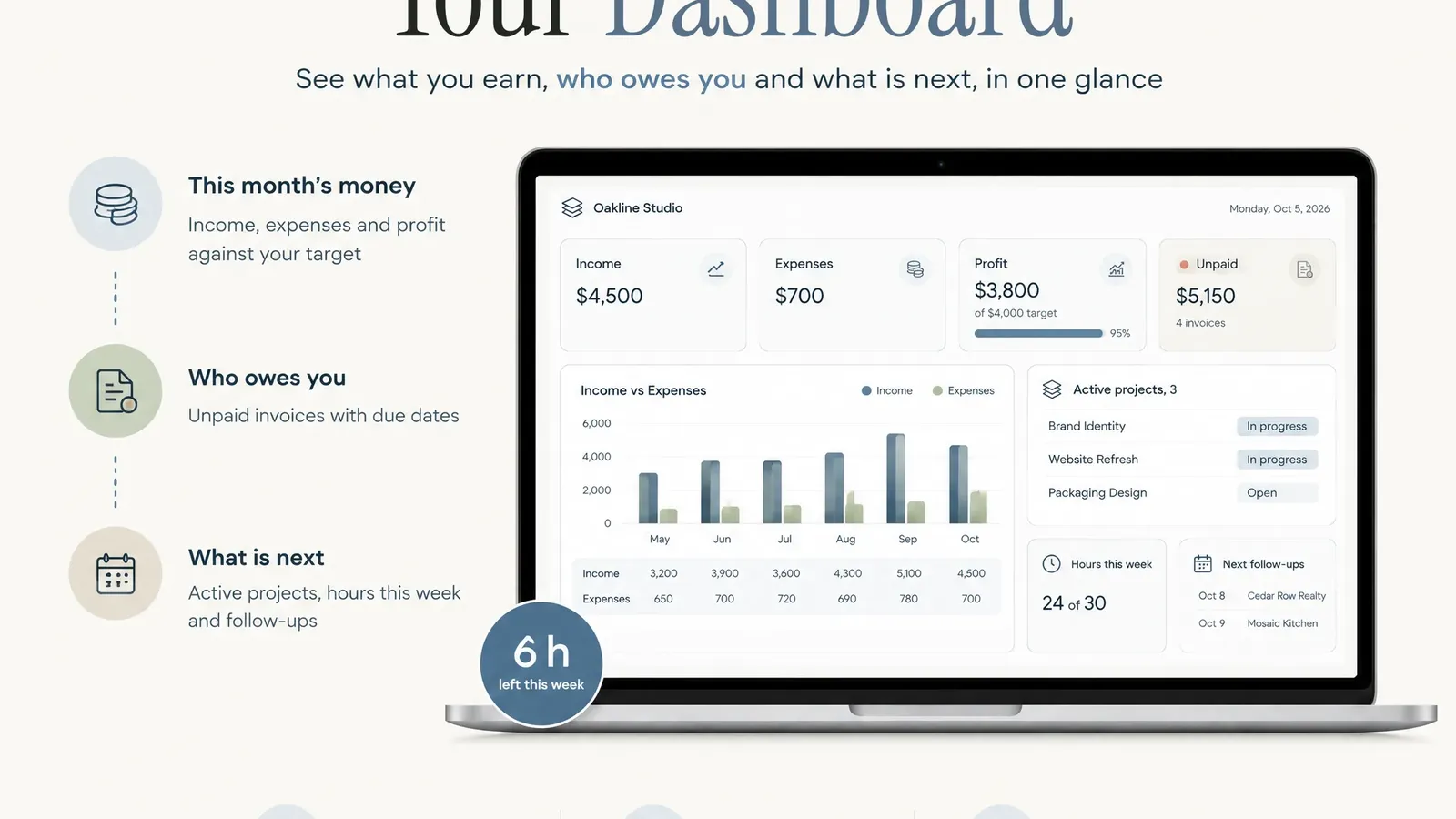
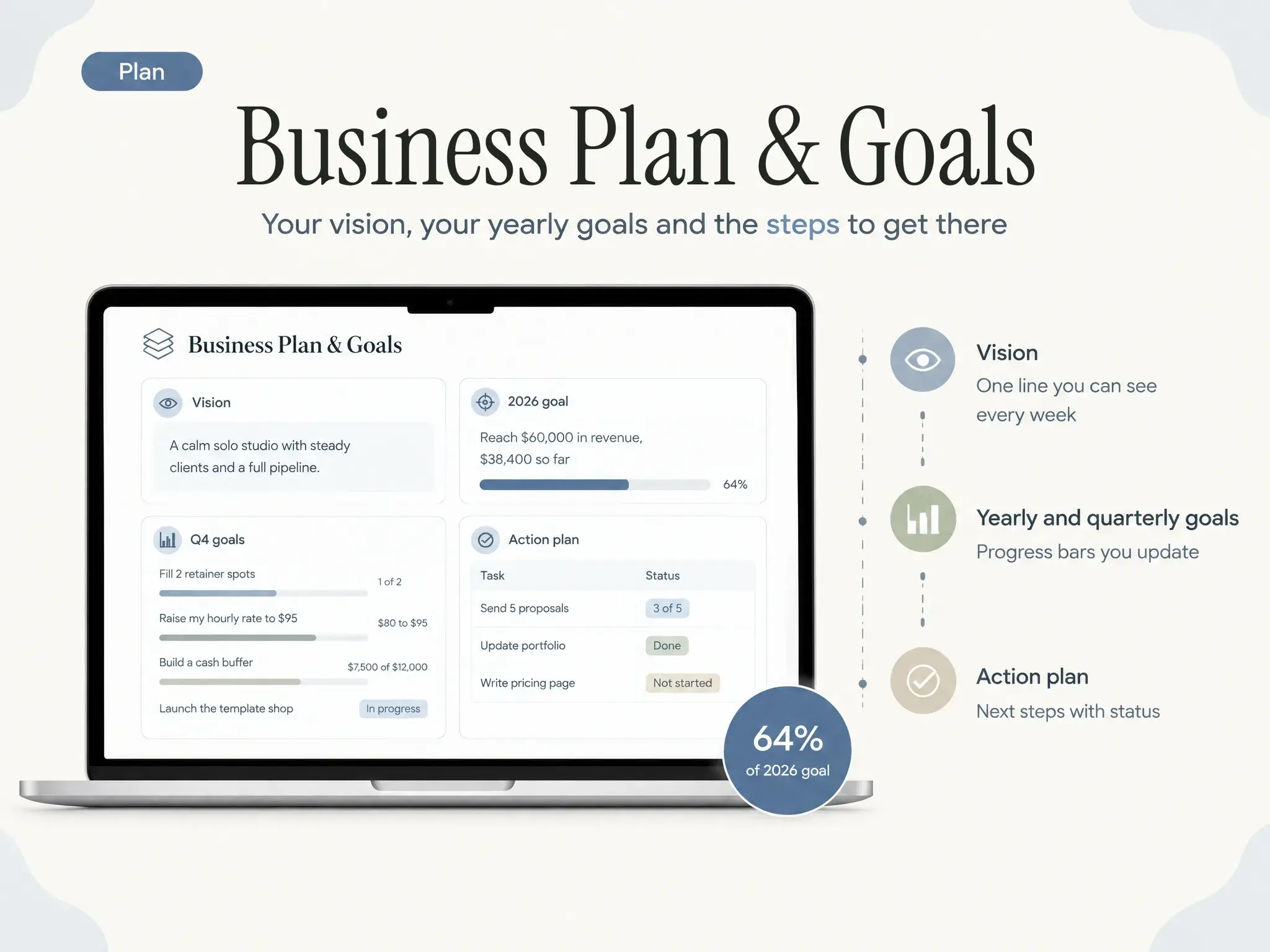
Its contents, summarised briefly: a dashboard with income, expenses and profit against your target, and invoices marked paid or unpaid. A client pipeline with follow-up dates. Projects with deadline, budget and hours. A Business Plan and Goals page with vision, yearly and quarterly goals and an action plan. A Brand and Services page with your services, pricing and the effective hourly rate per project. Daily, weekly and monthly planners with time tracking.
It is a one-time $9 purchase, and it operates on the free Notion plan. Every page comes with sample data, so you see how it works before you replace it with your own. It does not write the plan on your behalf. You still make the six decisions above.
If you want the pages ready, see the Notion business planner for freelancers.
Frequently asked questions
Do I need a business plan to freelance?
No. Nobody requires one to start freelancing. You need one if you apply for a loan or a grant, and it helps even without that, because it forces you to decide who you serve, what you charge and what income you want before the work piles up.
How long should a freelance business plan be?
One page is enough. The US Small Business Administration describes lean plans as typically one page, while traditional plans can run to dozens of pages. A solo service business rarely needs more than the lean version.
What should a freelance business plan include?
Six things: who you serve, what you sell, your price, your income target, how clients find you, and your goals for the quarter. If a line does not change a decision you will make this month, cut it.
How often should I update my plan?
Once a quarter, with a short check each month. Compare income and hours to your target, then change one thing. A plan nobody reopens is a document, not a plan.
Can I make my freelance business plan in Notion?
Yes. Notion works well because the plan can sit next to your clients, projects and money. The free Notion plan is enough for a single-person workspace.
Is a plan different from a budget?
Yes. A budget covers money. A plan also covers who you want as clients, what you sell and how you will find them. The money section of the plan is the part that overlaps.
What is the fastest way to start?
Fill in the six lines below with rough numbers, then improve them in your first review. A ready-made Notion business planner can save the setup time, but the decisions are still yours.
Sources
Keep reading
Plan the Business
Quarterly Planning for a One-Person Business: A 3-Hour Session, Step by Step
Quarterly planning for one person, run as a single session: review last quarter, count your real hours, pick up to three goals and book your review dates.
· 9 min read
Plan the Business
Marketing Plan Template for Small Business: A One-Person Channel Plan
Marketing plan template for small business: organize your buyer, offer, channels, actions, and review dates in one clear plan for a solo service business.
· 9 min read

Plan the Business
Small Business Goals: Three You Can Track Each Month
Choose three small business goals for delivery, demand, and money, then track each with a baseline, target, next action, and monthly review.
· 8 min read
