Small Business Goals: Three You Can Track Each Month
Choose three small business goals for delivery, demand, and money, then track each with a baseline, target, next action, and monthly review.
By Notion Business Planner by Cosmo Suite · Editorial policy
Published · 8 min read

Small business goals become easier to act on when each one answers a different question. A small business goal is a defined result the owner plans to reach within a stated period. A solo service owner can track delivery, demand, and money on one monthly page, then choose a next action from what changed.
The page does not need a long list of ambitions. Start with a result you want, the current baseline, a target and date, and one action you can take. The example below uses fictional figures and shows how to review the result without treating one month as a verdict on the whole business.
Key takeaways:
- Choose a delivery goal, a demand goal, and a money goal that match current priorities.
- Record the baseline, target, next action, and review date for each one.
- Pair outcomes with actions you control, while keeping the two measures distinct.
- Review the evidence before you keep, adjust, or stop a goal.
Small Business Goals at a Glance
Three kinds of goals can show whether work is moving, whether new work is developing, and whether the business is meeting a financial target. The right measure depends on your service and records.
| Goal area | Example measure | Action you can control | What the review can tell you |
|---|---|---|---|
| Delivery | Projects completed by the agreed date | Confirm the next milestone with each active client | Whether commitments and capacity need attention |
| Demand | Qualified inquiries received | Follow up on open conversations or publish a useful offer page | Whether your current outreach is producing conversations |
| Money | Collected income compared with a chosen target | Review quotes, invoices, and planned work | Whether the target and current work are aligned |
The categories help a solo owner avoid reading one result as the whole story. If revenue is below target, an inquiry measure can show whether fewer prospects arrived, while a delivery measure can show whether capacity was already full. Those measures do not explain cause by themselves, but they help identify which records to check next.
SCORE's one-page business planning guide places goals alongside market, sales, and financial planning. The SBA's business planning guide connects revenue targets with cost analysis. Use those as prompts to choose measures relevant to your own work.
Choose Three Goals That Answer Different Questions
Three goals work best when they do not all measure the same outcome. If each one is a sales target, you may know whether revenue moved but not whether the offer reached enough prospects or whether delivery has room for new work.
Start with one question in each area:
- Delivery: What commitment should move forward or finish?
- Demand: What evidence would show that prospective customers are responding?
- Money: Which financial result should you review against a target?
You can leave a category out if it does not fit this month. A business that is at capacity may not need a lead-generation target. Someone still testing a service might not have enough sales history to set a meaningful monthly income target. Write down why you chose the measures so you can revisit that choice later.
Separate an outcome from an activity. “Receive four qualified inquiries” is an outcome; “send five follow-up messages” is an action. The action is within your control, but it does not guarantee the outcome. Track both when that distinction will help you understand what happened.
For more on selecting a small number of quarterly priorities, use this quarterly goals template guide. If your main question is what to review each month, see the monthly business review for a solo owner.
Write a Goal You Can Review
A reviewable goal names the measure, the starting point, the target, an action, and the date you will check it. The baseline is the starting value you compare with the later result. SCORE recommends making business goals measurable and time-specific; a date gives you a point to compare with the result.
| Field | What to write | Example |
|---|---|---|
| Goal | The result you want | Complete active design projects on their agreed dates |
| Measure | How you will count it | Projects delivered by agreed date |
| Baseline | What is happening now | 3 of 4 projects in the previous month |
| Target and date | The result and the period | 4 of 4 projects in the coming month |
| Next action | A step you can take | Confirm the next milestone with each client on Monday |
| Review rule | What you will decide after checking | If a date moves, record why before changing the target |
The sample baseline is only a starting record in a fictional example. If you do not have a clean baseline, first define how you will count the result. A measure that changes meaning each month cannot show a useful trend.
Keep the target within the period you can observe. “Grow the business” is too wide for a monthly check. “Send a project proposal to each qualified inquiry within two business days this month” names a process that can be tracked. The business result may take longer to appear, so do not present the action count as proof of growth.
A Fictional Solo Designer's Monthly Goal Scorecard
This fictional example shows how three goals can cover different parts of a one-person service business. The sample figures are for illustration only and do not describe a real customer, company, or typical result.
| Area | Baseline | Monthly target | Review result | Next decision |
|---|---|---|---|---|
| Delivery | 3 of 4 projects delivered by agreed dates | 4 of 4 | 3 of 4 | Check which milestone moved and why before accepting another deadline |
| Demand | 2 qualified inquiries last month | 3 this month | 2 | Review whether the planned outreach happened; keep the count separate from booked work |
| Money | $6,200 collected last month | $7,000 collected | $6,500 | Compare paid invoices and timing with the target; do not count unpaid invoices as collected |
The money difference is $500: $7,000 minus $6,500. That tells the designer how the month compared with the chosen target. It does not, by itself, explain the cause or show profit. The delivery result says one date slipped, but the table does not tell us whether the cause was scope, client feedback, capacity, or an estimate. The next action is to check the project record.
An inquiry count also needs context. If the two inquiries match the intended service and one is still in discussion, that may suggest a different next step than two inquiries for unrelated work. Keep a short note on what counted as qualified, and use the same definition during the next review.
For example, a solo owner with no open project slots may decide to improve follow-up quality instead of increasing the number of inquiries. A capacity record helps explain why the demand target should change for that month.

The value of this scorecard is the link between a result and the next record to inspect. The delivery result points to a project milestone, the inquiry count points to a follow-up record, and collected income points to invoices and payments. The sample numbers are not a forecast. Replace them with your own records and keep source documents for financial entries.
When a Goal Misses Its Target
A missed target is a signal to investigate, not an automatic instruction to work longer or change the number. First check whether you recorded the result the same way as the baseline. Then look for a specific reason you can support with your records.
Use this short sequence:
- Check the measure. Did you count completed projects, signed projects, or paid projects? Those are different results.
- Check the action. Did the planned follow-up, quote, or milestone check happen?
- Check the context. Did the scope, client timing, capacity, or priority change?
- Choose one response. Keep the goal, adjust the action or target, or stop tracking it if the priority no longer matters.
- Set another date. Give the next step an owner and a time to review it.
SCORE's mid-year review guide recommends checking whether goals remain relevant, reviewing progress, and identifying what is getting in the way. The same questions can guide a monthly check when your records support that timing. If the planned period changed or the data is incomplete, record what you know and what still needs checking before deciding whether to change the goal.
Keep the Review Small Enough to Repeat
A monthly review should take less time than it saves. Put the three measures in one view, update them from existing records, and finish with a short decision note.
Try a 20-minute pass:
- Minutes 1-5: update each measure and note its source.
- Minutes 6-10: compare result with baseline and target.
- Minutes 11-15: identify the biggest gap or useful change.
- Minutes 16-20: choose one next action and set its review date.
Keep the source next to the number. A project record can support a delivery count. Inquiry notes can support a demand count. Invoices and payment records can support collected-income figures. This is a management summary, not a replacement for accounting records, receipts, or professional advice.
If the same measure takes too long to assemble every month, simplify it or change the review schedule. A goal that depends on information you do not collect is not yet measurable in practice. Start by deciding what record would answer the question, then review again after you have enough data.
Where Notion Business Planner Fits
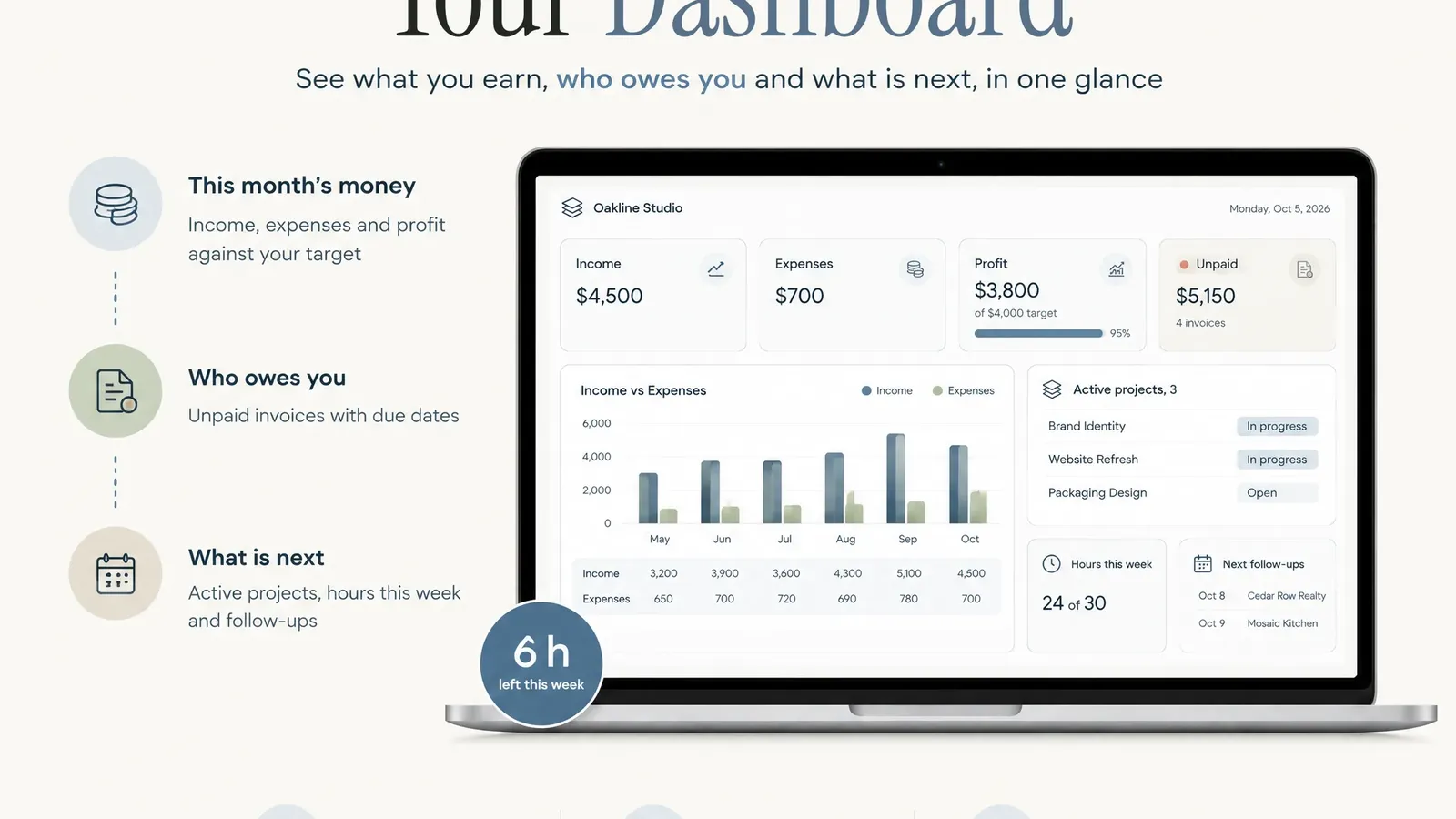
Notion Business Planner can hold a business plan, goals, services, projects, clients, and finance pages in one Notion workspace, based on its published contents. The goal itself still depends on your choice of measure, target, action, and review date.
You can set up those fields in a database, a spreadsheet, or a paper notebook. Keep the definition consistent and link a financial summary to the records that support it. Notion Business Planner is one option if you want the planning pages alongside client and project information. Its Business Plan & Goals page can hold goal notes with other planning details, while project pages can hold work and hours. The target still depends on your business priorities and records.
To set the broader direction first, read the one-page freelance business plan guide. To track the work signals that can shape your weekly routine, see what a one-person business can track.
Notion Business Planner by Cosmo Suite publishes this guide. See the site's editorial policy and about page for how it handles corrections and contact.
Frequently asked questions
What are good goals for a small business?
Choose goals tied to a current need, such as completing client work on schedule, following up with qualified leads, or comparing monthly income with a target. Give each a baseline, a target, an action, and a review date.
How many goals should a small business have at once?
There is no fixed right number. A solo owner can start with three goals that cover different questions: delivery, demand, and money. If you cannot review them consistently, reduce the list.
What is an example of a measurable business goal?
A fictional example is: send a project update to every active client by Friday for the next four weeks. It names an action, a group, and a time window. Add a baseline if you have one.
How often should I review small business goals?
Review progress monthly if that matches the measure. A weekly check can help with actions and deadlines. Change the review timing when the underlying information arrives on a different schedule.
Can I track business goals in Notion?
Yes. Notion can hold a goal, its measure, next action, and review date. Keep accounting records and source documents in the system you use for those records.
What should I do if I miss a business goal?
Check whether the measure is current and whether the planned action happened. Then keep the goal, adjust the action or target, or stop tracking it if the business priority changed. Record the reason for the decision.
Sources
Keep reading
Plan the Business
Freelance Business Plan: A One-Page Plan You Can Fill In Today
Freelance business plan in one page: six sections to fill in, a worked example for a solo designer, and a quarterly review so the plan stays alive.
· 8 min read

Plan the Business
Quarterly Goals Template for a One-Person Business
Quarterly goals template: set three goals, record a baseline, schedule monthly reviews, and track progress in your one-person business each quarter.
· 8 min read

Plan the Business
Quarterly Planning for a One-Person Business: A 3-Hour Session, Step by Step
Quarterly planning for one person, run as a single session: review last quarter, count your real hours, pick up to three goals and book your review dates.
· 9 min read
