Day Rate vs Hourly Rate: How to Quote a Project
Day rate vs hourly rate: compare fees for one freelance job, find your break-even hours, and define the workday before you send a quote.
By Notion Business Planner by Cosmo Suite · Editorial policy
Published · 9 min read

A day rate and an hourly rate can both price the same freelance job. Compare the fee for the agreed work, then state how many hours the day rate covers.
Use hourly billing when the task list may change and time is easy to track. A day rate can suit a client who reserves a defined block of your working time. The example below shows the break-even point and the quote details to settle before work starts.
Key takeaways:
- Convert an hourly rate to a day rate using the billable hours in your defined day.
- Compare the same work and the same scope before choosing a billing unit.
- Put the day length, deliverables, client access, and extra-time rules in writing.
- Review fee ÷ actual project hours after delivery to see what the quote produced.
Day Rate vs Hourly Rate at a Glance
An hourly rate is the fee for each approved billable hour. A day rate is the fee for an agreed block of working time. The better fit depends on whether you can describe the work and its time boundary before you start.
| Billing unit | Fee calculation | Often fits | Main question to settle |
|---|---|---|---|
| Hourly | Rate × approved hours worked | Ongoing support or work with changing tasks | What is the estimate, cap, or approval point? |
| Day | Rate × agreed days reserved | A planned block of focused work or a defined workday | How many hours and what access does one day include? |
| Fixed project fee | One total for agreed deliverables | A defined result with a clear scope | What counts as included work and a change? |
The third row matters because a day rate and a fixed project fee are different units. A day rate is attached to time blocks. A project fee is attached to a deliverable. You can use your hourly rate to estimate either one, but the quote should say which deal you are offering.
With hourly billing, the final fee changes as approved hours accumulate. A day quote gives the client a price for a reserved block. In both cases, list the included work and explain how you will handle a change. A Notion business planner for solo work can keep service pricing and project records together.
If you need to calculate the underlying hourly figure first, this hourly rate calculator walkthrough shows how a target income and available billable time affect that baseline. Use your own assumptions; another freelancer’s rate is not a substitute for your costs, capacity, or desired income.
Find the Break-Even Point With One Example
Multiply your hourly rate by the number of billable hours in the day you defined. That gives a comparable day-rate amount for the same work. The example below uses fictional numbers to show the arithmetic, not a market rate.
For example, assume a solo designer quotes $90 per hour. For one job, the designer offers a day rate of $630 and defines one day as seven billable hours. The comparison is:
| Actual project hours | Hourly fee at $90/hour | Day fee for one reserved day | Fee per actual hour at the day rate |
|---|---|---|---|
| 6 | $540 | $630 | $105.00 |
| 7 | $630 | $630 | $90.00 |
| 8 | $720 | $630* | $78.75* |
The two quotes break even at seven hours: $90 × 7 = $630. At six hours, the reserved day costs more than six hourly hours. At eight hours, the work has passed the stated day boundary. The $630 fee covers that extra hour only if the designer agrees to absorb it. The quote should say whether more time needs a new approval or fee.
Compare like with like when you use this formula. If the hourly estimate includes preparation but the day rate covers only the booked session, the two figures describe different work. Include the same preparation, calls, revisions, and handoff time on both sides of the calculation, or state clearly why the quote treats them differently.
The break-even formula is simple:
Equivalent day rate = hourly rate × billable hours in the defined day
For another example, $120 an hour across a defined six-hour day gives a $720 day rate. State the number of hours in the agreement. Use the time the client is reserving, rather than every hour in a calendar day that also includes unrelated work.
This quote comparison leaves out expenses, payment delays, and time spent finding the client. For a closer look at fee divided by logged hours after a fixed-fee project, see this guide to effective hourly rate by project. Keep the quote amount, the hours worked, and payments received as separate facts.
When Hourly Billing Fits Better
Hourly billing is easier to adjust when the client is still defining the work or sends ongoing requests. The fee rises with approved hours, so both sides can see how each change affects the total.
Set a budget or hour limit and tell the client when you will pause for approval. A designer could finish a two-hour research block, then ask before spending another hour on options. Choose the threshold for the project.
The estimate can still help when the final task list is uncertain. Tell the client what assumptions it uses and when you will revisit it. If priorities change, note the new task and confirm how it affects the time budget. That gives both sides a clear point to choose between continuing hourly work, reducing scope, or agreeing on a new day block.
Time records help explain the work and improve the next quote. Decide whether project calls, research, revisions, preparation, and handoff count as billable time. Apply the rule consistently for that service. Add a short note to each entry when projects have similar names.
Record time close to when you do the work. If you wait until the end of the week, short calls and quick revisions are easy to miss. A rough entry marked as an estimate is more useful than a precise total that leaves out parts of the job. Keep general marketing or bookkeeping time separate unless you are measuring a business-wide rate rather than one project's return.
Hourly billing can feel awkward when work is fast because the fee follows time spent. Unclear expectations can also lead to close monitoring. State what the client receives, what the estimate covers, and how you will approve added requests. For a firm budget, agree when you will report the remaining hours.
For recurring tasks, a simple log can show which activities fill a week and which jobs regularly run over. Separate project hours from general admin time, then use the same distinction when you compare hourly and day-based work.
When a Day Rate Fits Better
A day rate can suit work planned well enough to use a reserved block of time. A workshop, a focused production day, or a prepared set of tasks may fit. The client can budget by day, and you can plan availability around the booking.
Define the day in the quote. State the start and end window, included hours, whether the client can contact you during that period, and expected deliverables. Explain how you handle breaks, preparation, travel, or work beyond those hours. For remote work, say whether you reserve the day for that client.
If your defined day has seven billable hours, distinguish those hours from the full time on your calendar. A lunch break or unrelated project does not become part of the client’s block unless you include it.
The day rate covers the work listed for that block. If the client adds a deliverable halfway through, pause and agree what moves, what waits, or whether you need another day. The client can then see what the fee covers and when you need a new decision.

Before setting the price, include the time around the booked day: preparation, calls, cleanup, and handoff. If a $630 day rate also requires two hours of preparation outside the day, the fee divided by nine total hours is $70 an hour before expenses. This hypothetical check does not show take-home income.
Compare the result with similar completed jobs. If the rate falls after you add preparation time that you often miss, revise the scope, price, or billing method. This hourly-rate guide for solo service work works backward from costs and target income.
Compare a Day Rate and a Fixed Project Fee
A day rate charges for an agreed time block. A fixed project fee charges one total for agreed deliverables. The work can overlap, but the client buys a different unit. A day-rate quote is based on reserved days; a project fee comes from estimating the time and scope for the deliverable.
Upwork's overview of hourly and fixed-rate projects describes fixed-price work as a total agreed upfront for defined deliverables, while hourly work charges for time worked. A day rate is a third arrangement: a day of your time for a defined fee. The Upwork article addresses fixed-price terms, so use it here only to distinguish those terms from hourly billing.
Billing unit and payment schedule are separate choices. Hourly work may be billed weekly or monthly. A day rate may be paid before or after the booking, and a fixed project fee may be split into milestones. Set the payment terms in the proposal or agreement, and check the local rules for your business.
For a project fee, include more than visible production hours. Upwork's fixed-price estimating guide recommends estimating hours and accounting for revisions, communication, and project risk. The guide covers fixed-price projects; your day-rate terms still need their own boundary.
What Actually Protects Your Rate
The quote should name the work, its boundary, and how you will handle changes. After delivery, divide the agreed fee by the project hours you count to find its effective hourly rate. Use this check before sending your quote:
- List the work. Include preparation, meetings, production, revisions, and handoff if they belong to the job.
- Choose the unit. Use hours when approved time is the cleanest fit; use days when the client is reserving defined blocks; use a project fee when deliverables are clear.
- Show the boundary. Include the estimate or days, included tasks, decision points, and what requires a revised quote.
- Review the result. After delivery, divide the fee by the project hours you chose to count. Note the method so comparisons stay fair.
A sample project can help check the math. Keep it separate from your work records. For each live job, save the quoted scope, approved changes, hours, fee, and payment status. The Freelancers Union payment questions recommend stating how you will charge for work beyond the original scope. Put that term in the quote before work begins.
Compare the result with the rate you planned. If a day repeatedly needs more hours than the quote includes, revise the boundary or price. When hourly projects grow as clients add requests, set an approval step. Completed projects give you a firmer basis for each change. A Notion planner with service rates, project budgets, and logged hours can keep the inputs beside your review.
Why Trust This Article
Cosmo Suite publishes Notion Business Planner, so we have an interest in the product named below. The examples use fictional figures, and the calculations are shown in full. The Upwork guides support the distinction between hourly and fixed-price work; Freelancers Union supports stating how extra work will be billed. We checked these sources on 14 November 2026. This post uses no market-rate survey or customer result. Our editorial policy explains how we prepare posts. Check contract terms and local requirements with an appropriate professional.
Where Notion Business Planner Fits
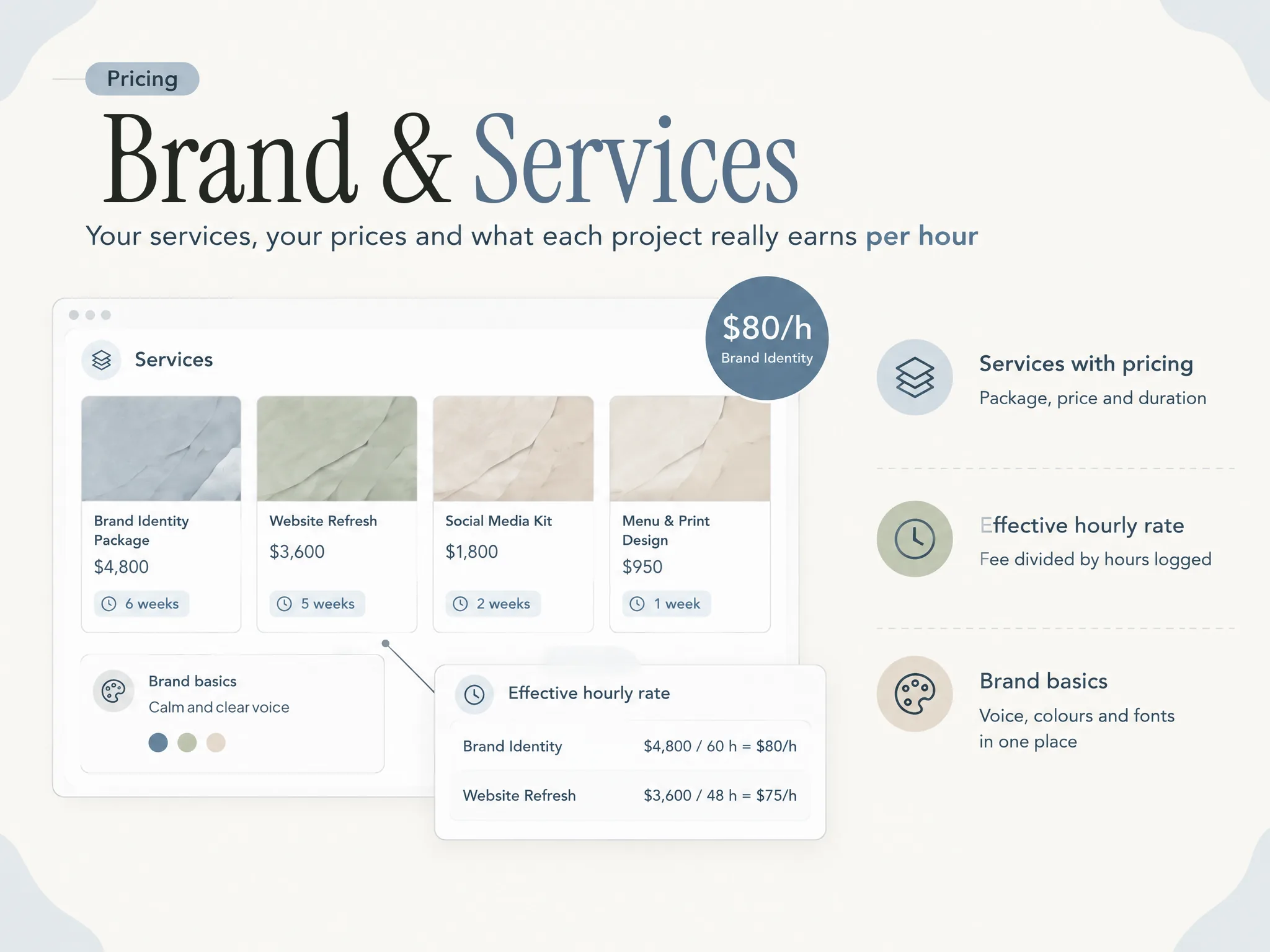
Notion Business Planner includes a Brand & Services page for service pricing and effective hourly rates, plus project pages for budgets and hours. These records can sit beside the time you log after delivery. The template does not set your day length or recommended price, and it does not replace a written client agreement.
You can make the same comparison in a spreadsheet or on paper. Notion Business Planner's freelancer planning template includes pages for pricing, projects, and hours. Use your completed work to adjust the next quote.
Frequently asked questions
Is a day rate cheaper than an hourly rate?
No. Compare the day rate with the hourly rate multiplied by the billable hours included in the agreed day. A lower day rate can still pay less per hour if the work runs beyond that boundary, so compare the same scope and record actual project time.
How many hours does a day rate cover?
There is no universal number. Put the hours, availability window, breaks, deliverables, and treatment of extra time in the quote. Use the same definition when you compare a day rate with an hourly quote.
How do I calculate a day rate from an hourly rate?
Multiply your target hourly rate by the billable hours in the day you have defined. At a hypothetical $90 an hour and seven billable hours, the equivalent day rate is $630. Add any separate preparation or costs consistently.
Can a freelancer switch from a day rate to hourly billing?
Yes, if both sides agree before the work continues. Record the point where the billing method changes, the hourly rate, and which tasks or hours it covers. This keeps the original day-rate work separate from later time-based work.
Should breaks or admin time be included in a day rate?
Say what the fee covers. A day rate may reserve a defined block of your working time, including agreed calls or preparation, while unrelated admin stays outside the project. The quote should explain availability and deliverables instead of leaving the client to guess.
How can I tell whether my day rate worked out well?
After delivery, divide the agreed fee by all project hours you chose to include, such as preparation, meetings, production, revisions, and handoff. Compare that result with similar work. It is a retrospective project rate, not take-home pay or a market benchmark.
Sources
Keep reading
Money and Pricing
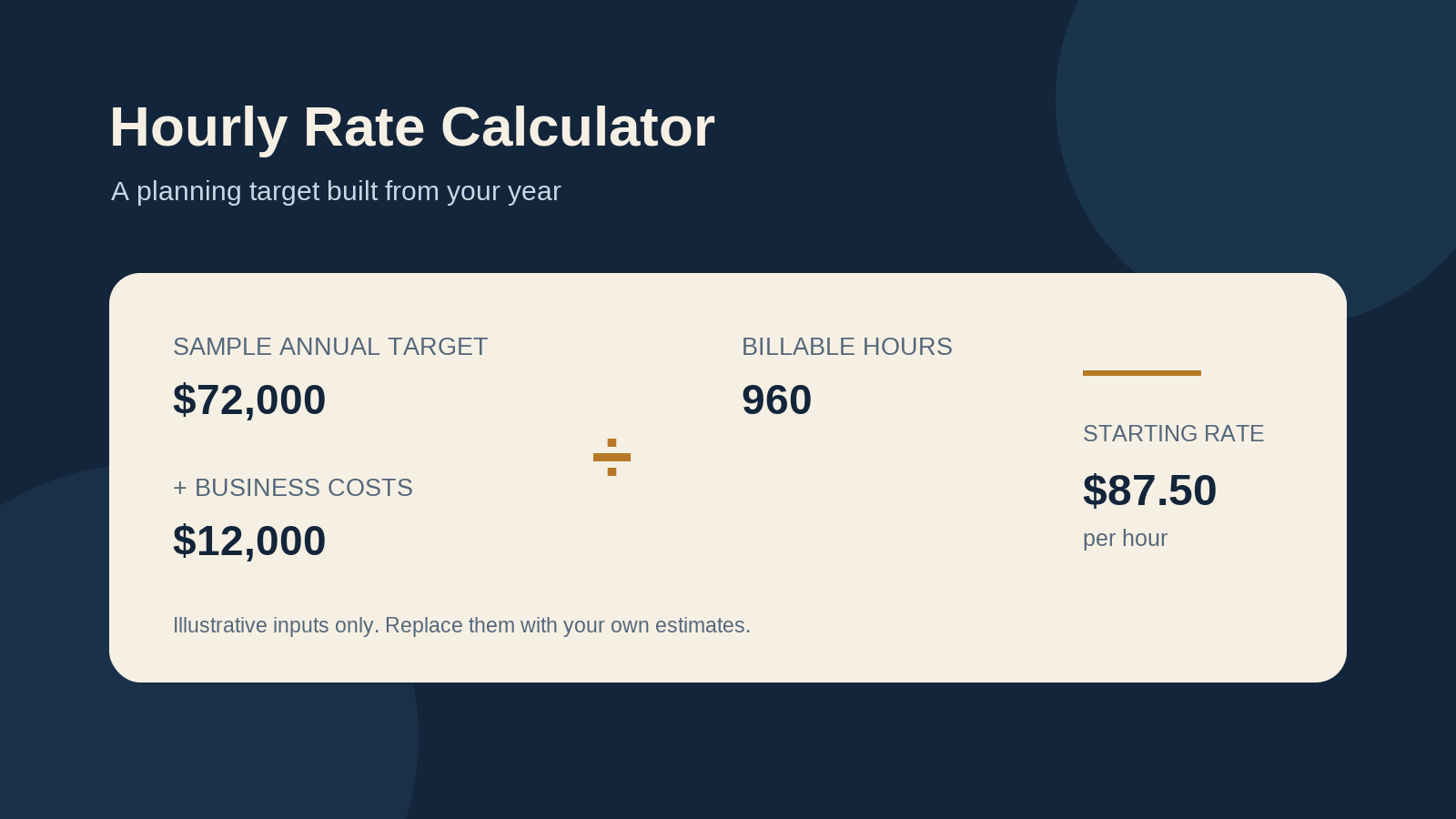
Hourly Rate Calculator: Set a Target From Your Workweek
Hourly rate calculator: turn an income target, business costs, and billable hours into a starting rate, then see how your workweek changes the result.
· 8 min read
Money and Pricing
Effective Hourly Rate: How to Calculate What a Project Pays
Calculate an effective hourly rate for fixed-fee work with a simple fee ÷ hours formula, three labelled project examples, and a checklist for your next quote.
· 9 min read

Money and Pricing
How to Price Services: Three Methods for a Clear Quote
How to price services: compare a cost floor, similar offers, and project scope with a practical quote method for solo freelancers and service providers.
· 8 min read
