Retainer Pricing: How to Set a Monthly Fee for Freelancers
Retainer pricing starts with hours or capacity times your target rate. See a hypothetical $1,600 example, three retainer models and the boundaries to set.
By Notion Business Planner by Cosmo Suite · Editorial policy
Published · 9 min read
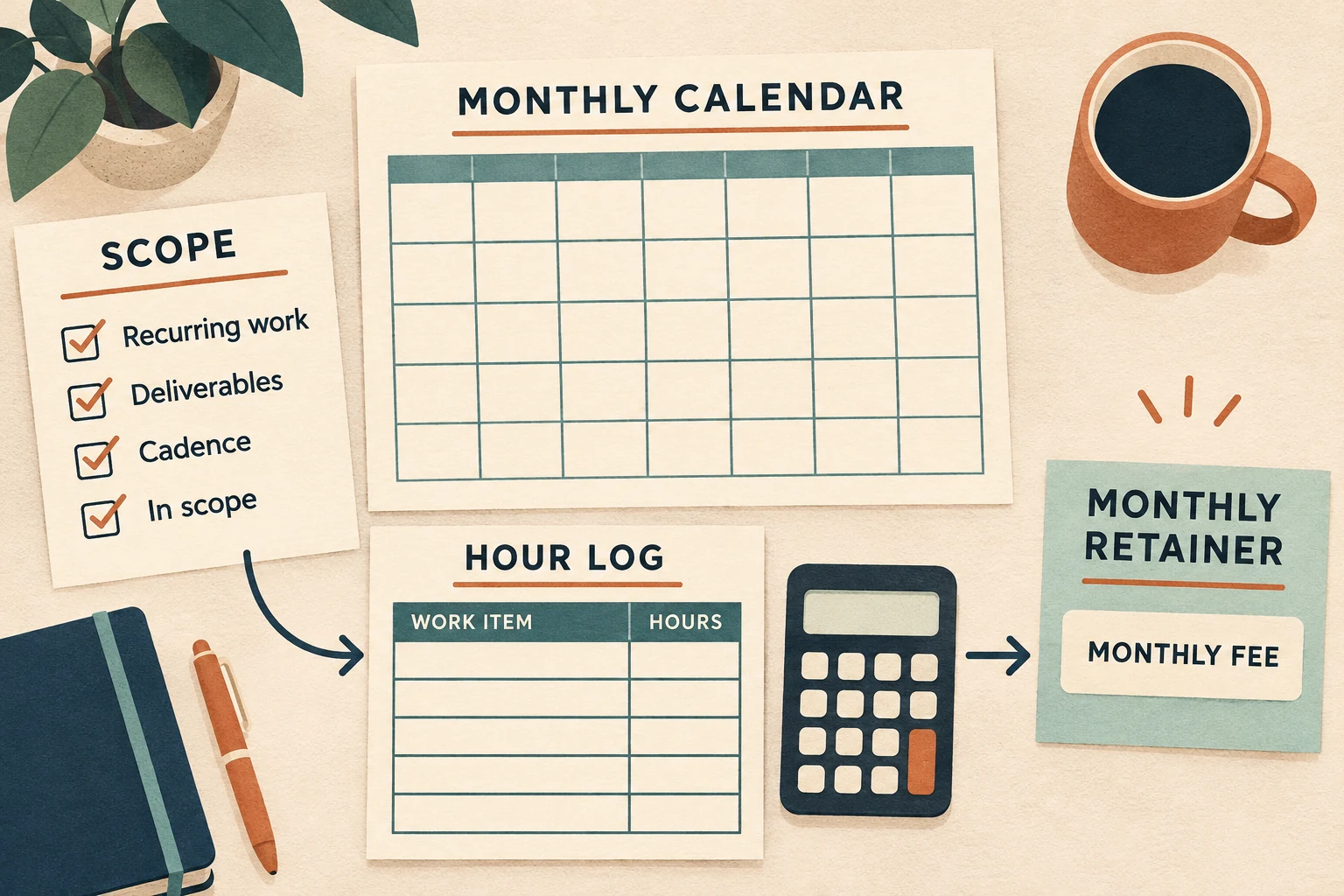
Retainer pricing for a solo service provider starts with three things: the recurring work or capacity you will include each month, a target effective rate that fits your own costs and billable hours, and one multiplication, hours times rate. In the hypothetical example below, 16 reserved hours at $100 per hour gives a starting fee of $1,600 per month. You then test that fee against reality by dividing it by every hour the client actually took.
Key takeaways:
- Starting fee = hours or capacity included × your target effective rate.
- Recalculate each month: actual effective rate = monthly fee ÷ all actual hours, including delivery and account communication.
- A retainer can price hours, defined deliverables or availability. Pick the one you can describe clearly.
- Decide the boundaries before the first month: included work, exclusions, extra requests, meeting time, unused capacity and a review date.
- The effective rate in this article is before business costs and tax.
What a Retainer Is, and Which Model You Are Pricing
Retainer pricing is setting a recurring fee for ongoing professional services. The IABC Toronto guide to independent communicators describes a retainer in similar terms: a set fee for recurring services, often based on the hours you expect to spend. That is one source's description, not a rule for every industry, and nothing here says a retainer is the right choice for you.
A monthly service retainer is different from a prepaid legal retainer or a deposit held against future work. The word is shared, but the arrangements differ. This article covers pricing and planning only. It does not draft contract clauses or explain legal effects, so take wording questions to a qualified professional.
An effective hourly rate is a fee divided by the hours spent to earn it. For a retainer, the useful check is the monthly fee divided by every hour spent on that client during the month.
Before you pick a number, pick what the number buys. There are three common ways to frame it:
| Model | What is priced | Useful when |
|---|---|---|
| Hours or capacity | A block of your time each month, such as a set number of hours | The work varies from month to month, but you can estimate the total effort |
| Recurring defined deliverables | A fixed list of outputs each month, such as a set number of pieces or reports | The tasks repeat and you can describe each one clearly |
| Availability | Your readiness to respond and be on call within the limits you set | The client mainly wants quick access to you, and you can protect the time that access takes |
You can combine models, but each added element gives you another input to estimate and review. If you want the simplest starting formula, use hours or capacity: those hours become the input you multiply by your target rate.
One detail changes how you read the result. An hours-based retainer can reserve calendar capacity that the client does not use. The fee divided by hours actually worked gives the rate for delivered time. It says nothing about other work you turned down because that time was held open. If availability is part of what you sell, review the time reserved as well as the hours delivered.
The Formula: Hours Times a Target Effective Rate
The calculation has two inputs, and both come from your own business rather than from a market price.
- Estimate the recurring work or capacity. List what the client needs each month and estimate the hours it takes. Include the delivery itself and the account communication around it: replies, short calls and updates. If you price deliverables, estimate the hours for each one and add them.
- Choose a target effective rate. This is the rate per hour you want the retainer to earn once all its hours are counted. It should make sense for your own costs and the number of hours you can realistically bill. SCORE's guide to pricing service businesses describes a cost-plus approach: add up overhead and the income you want, then divide by your billable hours. It also notes that value-based pricing is another way to set rates. Use that cost-plus logic to find your own rate. This article does not give a number to aim for.
- Multiply. Estimated hours × target effective rate = the starting monthly fee.

A hypothetical example
Everything in this example is fictional. The freelancer, the hours and the rates are invented to show the arithmetic, and none of it is a recommended rate or a typical result.
Suppose a hypothetical freelancer plans to reserve 16 hours a month for one client. Their personal target effective rate is $100 per hour.
- Starting fee: 16 hours × $100 per hour = $1,600 per month.
Now suppose the month ends and the logged time is 22 hours. That includes the planned delivery work plus calls, emails and small requests.
- Actual effective rate: $1,600 ÷ 22 hours = $72.73 per hour, rounded to cents.
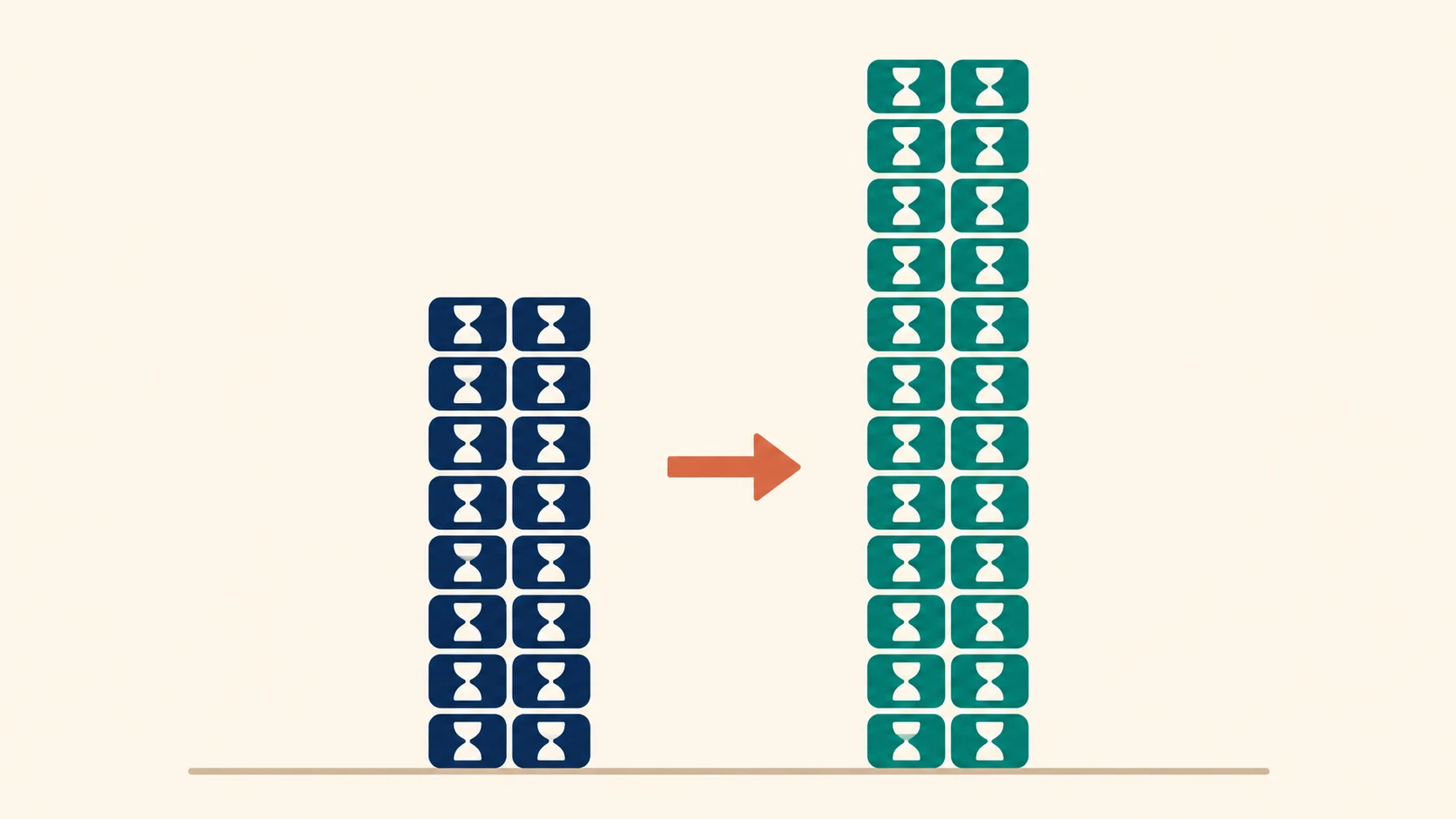
The gap between $100 and $72.73 came entirely from six extra hours. The fee stayed the same, so every extra hour lowered the rate. Track the actual rate, not just the planned one.
This effective rate is before business costs and tax. It compares the fee with hours. It does not show what is left after expenses, and it is not tax or accounting advice. If you want a refresher on the formula for a single project, see how to calculate an effective hourly rate.
Count Every Hour, Not Only the Billable-Looking Ones
One mistake is to divide the fee only by the hours spent on the main deliverable. That makes the rate look higher than the month actually earned.
For the actual effective rate, count all the time that month for that client:
- Delivery work.
- Meetings and calls, including preparation.
- Emails, messages and other account communication.
- Small requests handled between larger tasks.
- Admin directly tied to the account, such as sending a monthly summary.
A rough log is better than none, and an honest estimate marked as an estimate is better than a precise-looking total that leaves out the calls. If you work with several clients, assign time to the client it served so one account does not hide in another.
If you are working out which target rate to use in the first place, the hourly rate calculator walks through building a rate from your own numbers. For wider pricing choices across your services, see how to price services.
Boundaries to Decide Before the First Month
A retainer fee only works if everyone can tell what it covers. The IABC guide points out that unused capacity and time beyond the expected hours need clear treatment. That is an operating question, and it is easier to answer before the month starts than during a disagreement.
Decide these points and write them down in plain words you can share with the client. This is a planning checklist. It is not contract language, and it does not describe any legal effect.
- Included work. What the monthly fee covers, in specific terms: the hours, the deliverables or the availability window.
- Exclusions. What the fee does not cover, so a new type of task is recognised as new.
- Extra requests. How you will handle work beyond the included amount. For example, you might quote it separately before starting. Choose your own method and apply it the same way each time.
- Meeting and communication time. Whether calls and messages count toward the included hours, and how you will track them.
- Unused capacity. What happens when the client uses less than the planned amount in a month. Decide this before it happens, because it changes how you read the effective rate.
- Review date. When you and the client will look at the arrangement again, such as after the first month or the first quarter.
Without these, the 16-hour retainer in the example can quietly become a 22-hour one. With them, the extra six hours become a visible decision: quote them, absorb them once knowingly, or change the scope.
Review the Retainer Each Month
Set up a repeatable check so the retainer does not drift.
- Log the hours for the client as the month goes.
- At month end, add them up and divide the monthly fee by the total.
- Compare with your target. In the hypothetical example, $72.73 against a $100 target tells you something needs attention.
- Find the cause. Was it extra requests, long meetings, slow approvals or an underestimate of the base work?
- Choose one change. Adjust the estimate, tighten the included list, quote extras, or revisit the fee at the review date.
One month is a data point. Two or three months in the same pattern are a reason to act. If a result is better than your target, check that the work still matches what you promised before you decide anything. A fixed review slot in your week helps here, and the weekly business review for one person shows one way to build it.
Where Notion Business Planner Fits
Notion Business Planner is a Notion template for running a one-person service business. Its contents list includes a dashboard showing income, expenses, profit against target and unpaid invoices; a client pipeline with follow-ups; projects with deadline, budget and hours; Business Plan & Goals; a Brand & Services page with pricing and an effective hourly rate per project; and daily, weekly and monthly planning with time tracking.
For a retainer, the useful parts are the ones that hold hours and fees side by side. You can track a client's monthly work as a project, log the hours against it and compare the fee with the time at month end. The template does not calculate retainers and does not send invoices, so you do the multiplication and the division yourself, as in the example above. If you prefer a spreadsheet, the same fields work there: client, monthly fee, planned hours, actual hours, effective rate and a note about scope.
If you want the planning pages in one workspace, see Notion Business Planner.
Editorial Source Note
The Notion Business Planner team built the template described above and publishes this article, so we have a stake in the product. Read the product section with that in mind.
The freelancer, the 16 planned hours, the $100 target rate, the $1,600 fee and the 22 actual hours are all fictional and were made up to show the arithmetic. They are not client results, benchmarks or suggested prices. The arithmetic is our own: 16 × $100 = $1,600, and $1,600 ÷ 22 = $72.73, rounded to cents.
The sources were checked on 2026-11-16. SCORE's October 2025 pricing article describes the cost-plus approach of dividing overhead and desired income by billable hours, and notes value-based pricing as another approach. The IABC Toronto guide, created in 2007 and updated in 2015, describes a retainer as a set fee for recurring professional services, often based on anticipated hours, and says unused capacity and time beyond the expected hours need clear treatment. It is cited for that description, not as current legal guidance or universal practice.
Limitations: this article does not state a standard discount or a market price for retainers, and it does not offer legal, tax or accounting advice. The effective rate shown is before costs and tax. We have not described hands-on client work, because this is a planning guide built from the sources above and our own arithmetic. See our editorial policy and about page for how posts are drafted and corrected.
Frequently asked questions
How do you price a retainer?
Estimate the recurring work or capacity you will include each month, choose a target effective rate that fits your own costs and available billable hours, then multiply hours by that rate. After the month, divide the fee by all the hours you actually spent to see what the retainer really paid.
What is an effective rate on a retainer?
It is the monthly fee divided by every hour spent on that client in the month, including delivery, meetings, messages and other account communication. In the hypothetical example in this article, $1,600 divided by 22 hours is $72.73 per hour.
Is a monthly service retainer the same as a legal retainer?
No. In this article a retainer means a recurring fee for ongoing professional services. It is not a prepaid legal retainer or a deposit. This article does not give legal advice, so ask a qualified professional about contract wording.
What should I decide before starting a retainer?
Decide and write down what work is included, what is excluded, how extra requests will be quoted, how meeting and communication time is handled, what happens to unused capacity, and when you will review the arrangement. These are operating choices for your business, not contract language.
How often should I review a retainer?
Set a review date before you start, and compare planned hours with actual hours at the end of each month. A recurring review lets you see whether the fee, the scope or the hours need to change.
Sources
Keep reading

Money and Pricing
Effective Hourly Rate: How to Calculate What a Project Pays
Calculate an effective hourly rate for fixed-fee work with a simple fee ÷ hours formula, three labelled project examples, and a checklist for your next quote.
· 9 min read
Money and Pricing
Hourly Rate Calculator: Set a Target From Your Workweek
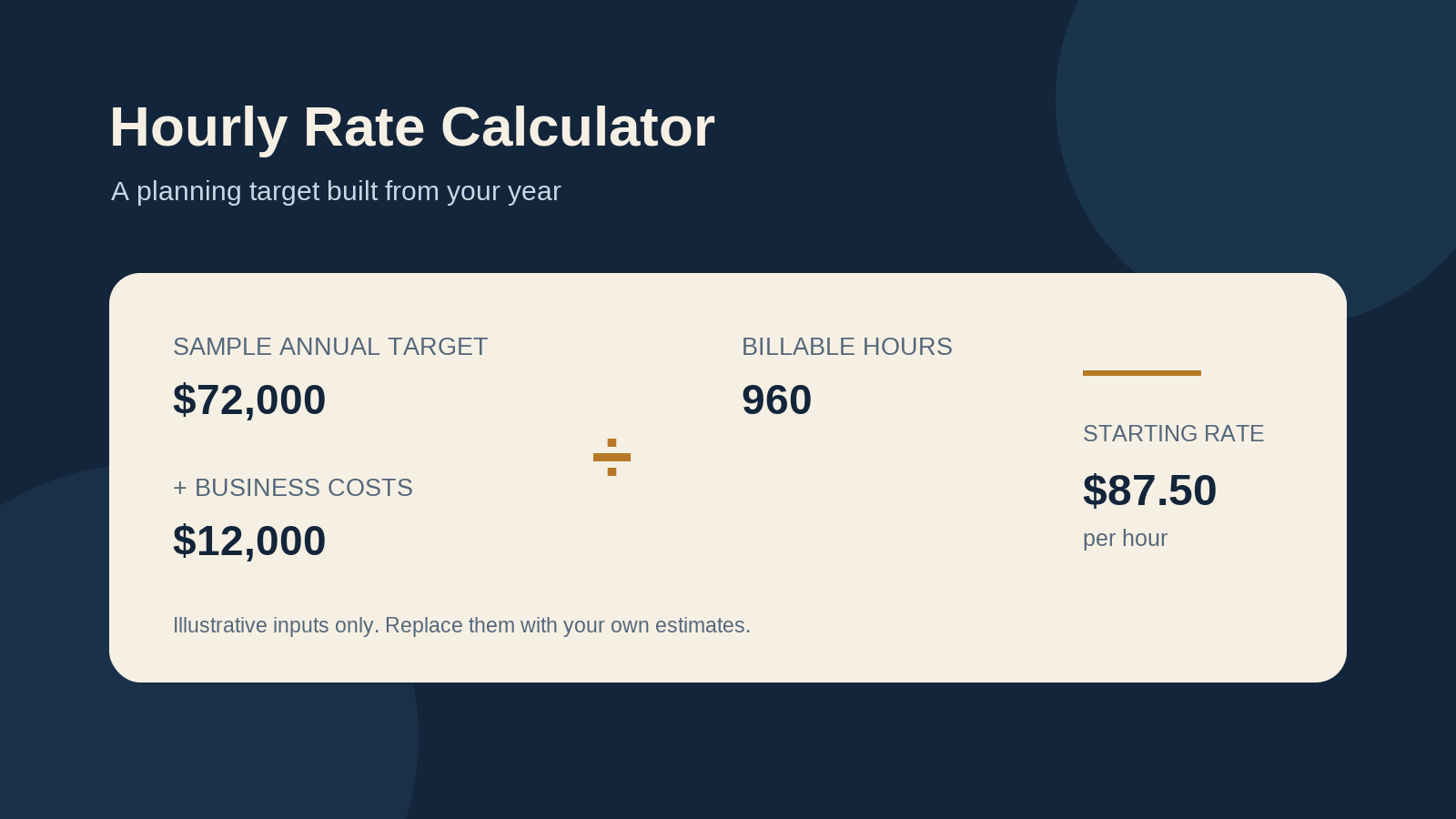
Hourly rate calculator: turn an income target, business costs, and billable hours into a starting rate, then see how your workweek changes the result.
· 8 min read

Money and Pricing
How to Price Services: Three Methods for a Clear Quote
How to price services: compare a cost floor, similar offers, and project scope with a practical quote method for solo freelancers and service providers.
· 8 min read
