Value Based Pricing for a Service Business: A Practical Method
Value based pricing for a service business starts with the result a client wants. Then you check the scope, evidence, and delivery risks before quoting.
By Notion Business Planner by Cosmo Suite · Editorial policy
Published · 9 min read

Value based pricing is a way to set a fee with a client's perceived benefit and willingness to pay in view. You still define the deliverables, check the evidence, and make sure the fee can support your time and costs. A hoped-for client result alone does not prove what a project should cost.
For a solo service business, start with the client's goal, compare realistic options, set a clear scope, and estimate the work. Then check that the fee and scope fit. A fictional website project below walks through those choices without treating a hoped-for gain as money already earned.
Key takeaways:
- Value based pricing considers the client's perceived benefit when setting a fee.
- The client outcome informs the discussion, while agreed deliverables define what you will provide.
- Your estimated hours, costs, and effective hourly rate remain useful guardrails.
- A project fee should not promise a result that depends on the client's decisions or other outside factors.
Value based pricing at a glance
Value based pricing considers what a client values and may be willing to pay, then checks that price against scope, alternatives, and delivery economics. It is not a fee formula based on a projected benefit alone.
| Step | Question | Record |
|---|---|---|
| Client outcome | What should be easier, clearer, or possible after the work? | A specific goal in the client's words |
| Evidence | What supports the expected benefit? | Current process, baseline, client estimate, or known constraints |
| Scope | What will you deliver and exclude? | Deliverables, review rounds, dates, and client inputs |
| Delivery check | What effort and costs will the scope require? | Hours, direct costs, and an uncertainty allowance |
| Quote | Which price and payment basis fit the work? | Fixed fee, milestones, hourly, or another agreed basis |
Harvard Business School Online describes value based pricing as setting prices with customers' perceived value and willingness to pay in view. The definition makes client value an input to the decision. It does not establish that the seller can measure every benefit precisely or capture all of it as a fee.
When this pricing method fits a solo service
Value based pricing is easier to discuss when a client can explain a meaningful outcome and you can define the work that contributes to it. A brand strategy project, a website redesign, and a workflow review may all be scoped around a business goal, but each still needs concrete deliverables.
The method is less straightforward when the client cannot describe the problem, the result depends on many other decisions, or the work is open-ended. You can still ask about the goal, but an uncertain benefit is not a substitute for a scope. For ongoing support, define what is included and use a review date.
| Situation | A useful pricing conversation | A caution |
|---|---|---|
| Clear deliverable and business goal | Connect the deliverable to the goal, then compare scope and fee options. | Avoid guaranteeing the business result. |
| Repeatable work with known effort | Use prior time records to estimate a fixed fee or hourly quote. | Past hours may not match a new scope. |
| Unclear request or shifting priorities | Start with a discovery step or narrow first phase. | Do not price an undefined project as if its boundaries were known. |
| Result depends on client action | State your work and the client's responsibilities separately. | Do not claim credit for outcomes you cannot control. |
The U.S. Small Business Administration recommends market research that includes what customers pay for alternatives and direct research with customers. For a service provider, that can mean checking comparable offers and asking a prospective client what they need to decide. Treat those answers as evidence to weigh, not as a universal rate card.
Build the quote from an outcome and a bounded scope
Start by asking what the client wants to change and how they will recognize progress. Then turn the answer into work you can describe. A client who says "we need a better website" may mean clearer service pages, a simpler inquiry path, a refreshed visual system, or all three.
Before choosing a fee, ask a few direct questions:

- What is happening now? Ask for the current process, problem, or example.
- What should change? Describe the result in observable terms, without adding an unsupported revenue promise.
- Who else affects the result? Note approvals, content, implementation, and decisions that belong to the client or another provider.
- What work is included? List the deliverables, meetings, review rounds, and handoff.
- What would change the quote? Identify new pages, extra revisions, delayed inputs, or added implementation.
Those answers give both sides something concrete to discuss. The SBA's market research guide suggests examining customer demand, competition, and what buyers pay for alternatives. A client interview adds detail about one buyer's priorities, while competitor research can help you understand the range of available approaches.
Keep the scope in plain language. "Improve the website" leaves room for different expectations. "Rewrite the home page and three service pages, provide two review rounds, and deliver the approved copy in a shared document" names what the fee covers. If design or implementation is outside the work, say so before the client approves the quote.
Check the fee against effort and uncertainty
Use your estimated effort and costs to test whether a proposed fee is workable for your business. This is a floor check, not a replacement for considering client value: it catches a quote that appears attractive but requires more time than the fee can support.
Consider this fictional example. A solo consultant is asked to audit an inquiry process and deliver a findings report, a revised inquiry form, and a handoff call. The client hopes to reduce missed inquiries, but neither side has a reliable baseline for how many opportunities are missed or what they are worth. The consultant estimates 18 hours for the agreed scope and uses a personal target rate of $100 per hour for this illustration.

| Quote check | Calculation | Result |
|---|---|---|
| Estimated labor floor | 18 hours × $100 | $1,800 |
| Direct project costs | Assumed research tools and subcontractor support | $300 |
| Simple cost floor | $1,800 + $300 | $2,100 |
| Proposed fixed fee | Example quote for the defined scope | $3,000 |
| Remaining before overhead and tax | $3,000 − $300 − $1,800 | $900 |
All values in this example are fictional inputs, not market rates or a recommendation. The proposed fee is not proven by the client's possible benefit. It is a discussion point that must be compared with the scope, alternatives, and the client's priorities. If the same work takes 24 hours instead of 18, the effective hourly rate on the $3,000 fee would be $125 before costs and tax. Use the effective hourly rate calculation to review completed fixed-fee work.
The estimate also needs room for uncertainty. If the scope relies on data the client has not gathered, list that as an assumption. You can narrow the first phase, price an additional research step, or set a decision point before the next phase. Each option gives you a clearer boundary than quietly absorbing unknown work.
Compare the pricing basis before you send a quote
Choose a pricing basis that matches how clear the work is and how both sides want to handle changes. Value based pricing can inform a fixed project fee, but hourly, milestone, or phased pricing may fit better when effort or requirements remain uncertain.

| Basis | It can fit when | Make clear |
|---|---|---|
| Fixed project fee | Deliverables and review limits are known. | Included work, exclusions, schedule, and change process. |
| Hourly | Requests may change or the work is hard to estimate. | Rate, time records, approval points, and any cap. |
| Milestones | The project has distinct stages and decisions. | What completes each stage and when payment is due. |
| Discovery phase | The problem or scope needs investigation first. | The discovery output and how later work will be quoted. |
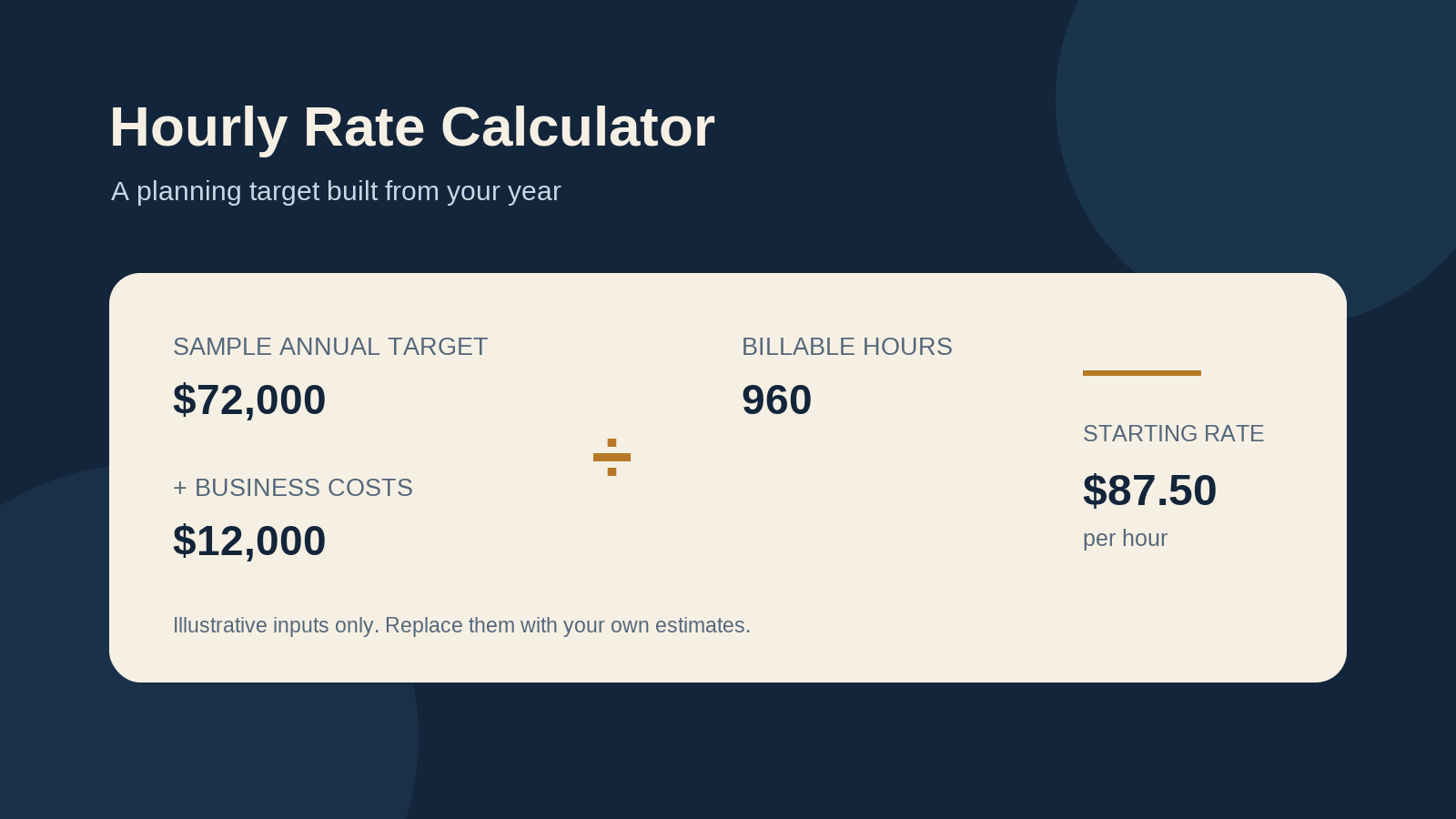
When the client prefers an hourly quote, the hourly rate calculator guide explains how to work backward from costs, income needs, and billable hours. The guide to pricing services compares several inputs to a quote. Whichever basis you choose, write down what happens when the work changes.
How to discuss the price with a client
Explain the connection between the client's goal, the work included, and the fee. A short proposal can state the problem as you understand it, the deliverables, the assumptions, the schedule, the price, and the process for extra work. This lets the client evaluate the proposal without relying on a promised return.
You can present two or three scope choices when the options are meaningfully different. For example, one option might cover an audit and recommendations, while another adds implementation support. Do not create artificial tiers that differ only in a higher price. Each option should have a clear deliverable and a reason it could suit the client's stated need.
Avoid turning a speculative benefit into a guarantee. If the client estimates that a process improvement could save time, record that estimate as the client's view and ask what assumptions it depends on. Your proposal can describe the work you control and the conditions needed for the wider result. Keep the fee attached to the agreed work rather than claiming a share of an outcome that has not happened.
What to review after delivery
After the project, compare the original estimate with the actual work and note what changed. Record the agreed fee, hours, direct costs, revisions, and scope changes. A short review can show whether the next quote needs a different boundary, estimate, or delivery process.
Check the client outcome separately. Did the deliverable solve the problem the client described? What evidence is available? If the result is unclear or depends on later decisions, record that honestly rather than turning an assumption into a case study. The SBA pricing strategy overview also emphasizes choosing a strategy that fits the business, market, and customers; your review can help you decide whether the chosen basis still fits.
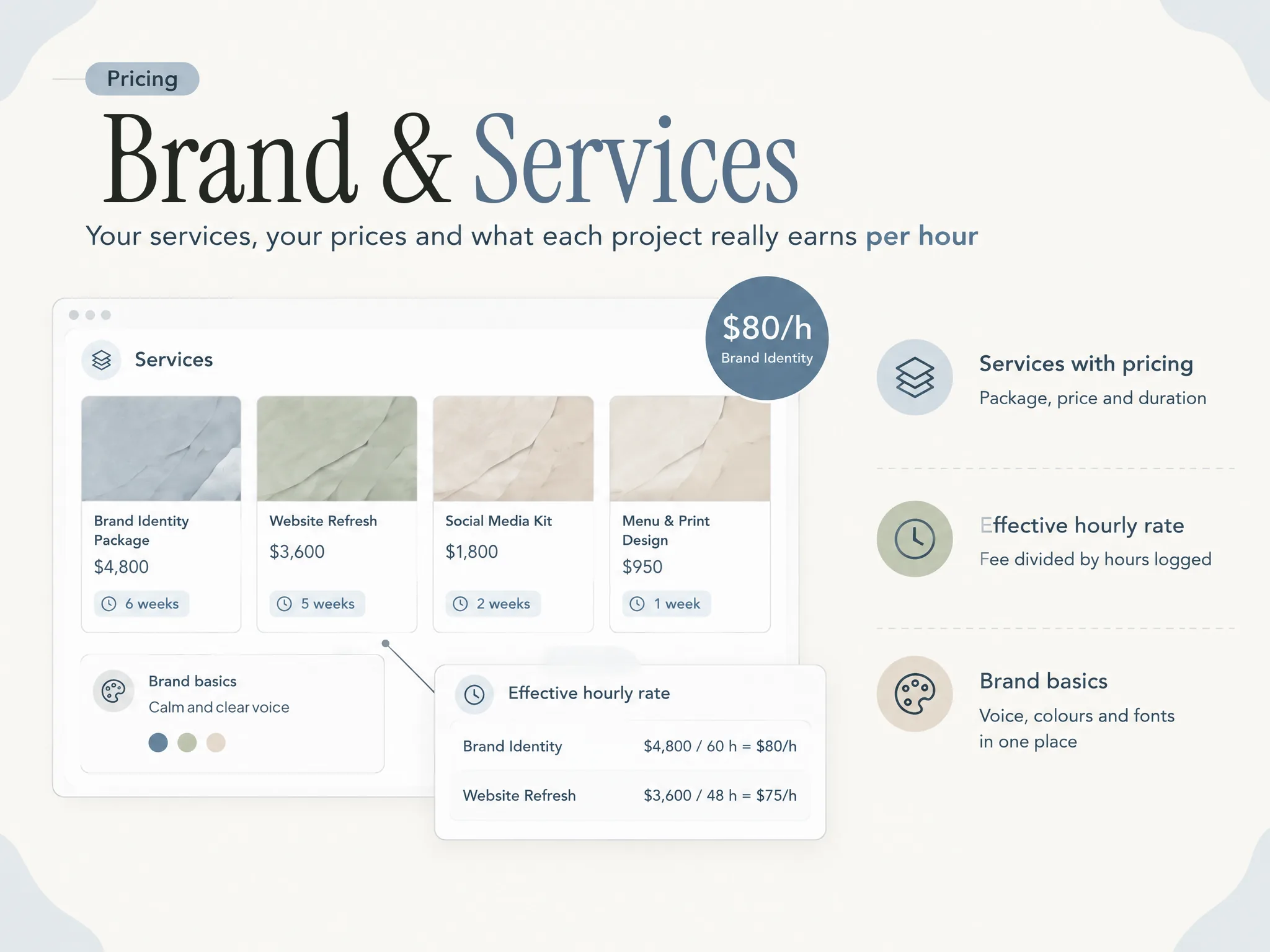
For a simple record, keep the service, client goal, deliverables, fee basis, estimated and actual hours, costs, and any change requests together. Notion Business Planner includes project pages for budgets and hours and a Brand & Services page for service pricing and effective hourly rates. You can also use a spreadsheet or another record system if that suits your work.
Why trust this article
This guide separates sourced definitions and market-research guidance from its fictional example. The calculations are shown with their assumptions, and the pricing choices are presented as options to evaluate rather than a universal rate formula. Notion Business Planner is made by the same publisher, so its mention below is a product reference, not an independent endorsement.
The publisher's about page identifies the company. The editorial policy explains that articles are AI-assisted, checked against cited sources, and open to correction. No client results or named author credentials are claimed here.
Where Notion Business Planner fits
Notion Business Planner includes a Brand & Services page for listing services, pricing, and effective hourly rate per project. Its Projects & Documents page holds project budgets and logged hours, and its dashboard shows income, expenses, profit against target, and unpaid invoices. These pages can keep quote assumptions and completed-project reviews in one workspace.
The template does not calculate a value based price or measure a client's return. You decide the pricing basis, define the scope, and enter the records. Compare its listed contents with the way you already work before choosing a record system.
Editorial source note
This article is published by the maker of Notion Business Planner, which is included as one possible record-keeping option. The consultant, client, scope, hours, costs, target rate, proposed fee, and every calculation in the example are fictional. They do not describe customer results, market benchmarks, or a recommended price.
The pricing explanation draws on Harvard Business School Online's overview of value based pricing and willingness to pay, the U.S. Small Business Administration's market research guidance, and business.gov.au's overview of pricing strategies. Those sources support the concepts described here; the worked example is original arithmetic using stated assumptions.
This guide is general business information, not financial, legal, tax, or accounting advice. Your costs, market, contract terms, and client circumstances may differ. Review local requirements and get qualified advice where needed.
Frequently asked questions
What is value based pricing?
Value based pricing uses the benefit a client expects and may be willing to pay for as inputs to a quote. Define the work, estimate the effort, and check that the fee supports your business.
How do I calculate a value based price?
Describe the outcome, gather evidence about its value, define the scope, and compare options. Use your hours and costs as a floor check; no single equation sets the right fee for every service.
Is value based pricing better than hourly pricing?
It depends on the service and how clearly the result and scope can be agreed. Hourly pricing ties the bill to time. A fixed project fee can make sense when the deliverables are clear, while hours remain useful for estimating effort and reviewing the result.
Can freelancers use value based pricing?
A freelancer can use client outcomes to shape a project fee, especially when the work has a clear boundary. The client benefit may be uncertain, so avoid promising a financial result you cannot control.
Should I charge a percentage of the value created?
A percentage can be hard to use when the value is difficult to measure or depends on factors outside your work. Agree on the deliverables, a fixed fee or another clear pricing basis, and how changes will be handled.
How do I avoid underpricing a fixed-fee project?
Estimate the hours for the agreed scope, multiply them by your own target rate, and include direct costs. Compare that floor with the client's priorities and alternatives, then adjust the scope or quote if the numbers do not work.
Sources
Keep reading
Money and Pricing
Effective Hourly Rate: How to Calculate What a Project Pays
Calculate an effective hourly rate for fixed-fee work with a simple fee ÷ hours formula, three labelled project examples, and a checklist for your next quote.
· 9 min read
Money and Pricing
Hourly Rate Calculator: Set a Target From Your Workweek
Hourly rate calculator: turn an income target, business costs, and billable hours into a starting rate, then see how your workweek changes the result.
· 8 min read

Money and Pricing
How to Price Services: Three Methods for a Clear Quote
How to price services: compare a cost floor, similar offers, and project scope with a practical quote method for solo freelancers and service providers.
· 8 min read
